|
|
March 1-15, 2011
Volume 19 - Number 5
$1
Prolétaires de tous les pays, unissez-vous!
Otatoskewak ota kitaskinahk mamawestotan!
Workers of all lands, unite
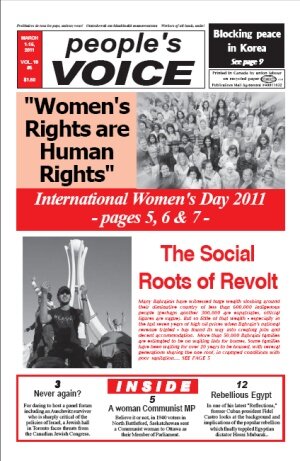
1) WOMEN'S RIGHTS ARE HUMAN RIGHTS
2) "NEVER AGAIN FOR ANYONE
3) HISTORIC EVENTS IN THE ARAB WORLD
4) TUNIS TO BAHRAIN TO WISCONSIN.... (Editorial)
5) ODIOUS EVENTS, SCARY IMPLICATIONS (Editorial)
6) NEEDED: AFFORDABLE, QUALITY, ACCESSIBLE, PUBLIC, NOT-FOR-PROFIT CHILDCARE
7) FIGHTING BACK DURING THE DIRTY THIRTIES
8) BAHRAIN: THE SOCIAL ROOTS OF REVOLT
9) DORISE NIELSEN: CANADA'S FIRST COMMUNIST MP
10) VENEZUELAN WORKERS BACK CHAVEZ GOVERNMENT
11) BLOCKING PEACE ON THE KOREAN PENINSULA
12) MUSIC NOTES, By Wally Brooker
13) THE REVOLUTIONARY REBELLION IN EGYPT
14) PV FUND DRIVE STARTS MARCH 1
15) WHAT’S LEFT
16) CLARTÉ (en français)
17) THE SPARK! (Theoretical and Discussion Bulletin of the Communist Party of Canada)
18) INTRODUCING MARX
19) PV MOBILE
PEOPLE'S VOICE MARCH 1-15, 2011 (pdf)
|
|
|
|
The Spark!The Spark! The latest issue of The Spark! theoretical journal, is now on sale for $5 at Communist Party offices (see p. 8) or People’s Co-op Books, 1391 Commercial Drive, Vancouver. Articles include
plus reviews, editorials, and more.
|
|
|
Theoretical and Discussion Bulletin of the Communist Party of Canada |
|

|
People's Voice deadlines: March 16-31 April 1-15 Send submissions to PV Editorial Office,
|
|
REDS ON THE WEB |
|
People's Voice finds many "Global Class Struggle" reports at the "Labour Start" website, http://www.labourstart.org/. We urge our readers to check it out! |
* * * * *
People's Voice
Canadian Publications Mail Sales Product Agreement #205214
ISSN number 1198-8657
People's Voice is published by
New Labour Press Ltd
PV Editorial Office
706 Clark Drive,
VANCOUVER, B.C. V5L 3J1
Phone:604-255-2041
Fax:604-254-9803
email: pvoice@telus.net
Editor: Kimball Cariou : Business Manager: Sam Hammond
Editorial Board: Kimball Cariou, Miguel Figueroa,
Doug Meggison, Naomi Rankin, Liz Rowley, Jim Sacouman
* * * * * *
Letters
People's Voice welcomes your letters
on any subject covered in our pages.
We reserve the right to edit for length and clarity,
and to refuse to print letters which may be libellous
or which contain unnecessary personal attacks.
Send your views to:
"Letters to the Editor",
706 Clark Dr., Vancouver, BC V5L 3J1,
or mailto:pvoice@telus.net
People's Voice articles may be reprinted without permission,
provided the source is credited.
* * * * * *
The Communist Party of Canada, formed in 1921,
has a proud history of fighting for jobs, equality, peace,
Canadian independence, and socialism.
The CPC does much more than run candidates in elections.
We think the fight against big business and its parties
is a year-round job,
so our members are active across the country,
to build our party and to help strengthen people's movements
on a wide range of issues.
All our policies and leadership
are set democratically by our members.
To find out more about Canada's party of Socialism,
give us a call at the nearest CPC office.
* * * * * *
Central Committee CPC
290A Danforth Ave Toronto, Ont. M4K 1N6
Ph: (416) 469-2446
fax: (416) 469-4063 E-mailmailto:info@cpc-pcp.ca
Parti Communiste du Quebec (section du
Parti communiste du Canada)
5359 Ave du Parc, Montréal, Québec,
H2V 4G9
B.C.Committee CPC
706 Clark Drive, Vancouver, V5L 3J1
Tel: (604) 254-9836
Fax: (604) 254-9803
Edmonton CPC
Box 68112, 70 Bonnie Doon P.O.
Edmonton, AB, T6C 4N6
Tel: (780) 465-7893
Fax: (780)463-0209
Calgary CPC
Unit #1 - 19 Radcliffe Close SE
Calgary AB, T2A 6B2
Tel: (403) 248-6489
Ottawa CPC
Tel: (613) 232-7108
Manitoba Committee
387 Selkirk Ave., Winnipeg, R2W 2M3
Tel/fax: (204) 586-7824
Ontario Ctee. CPC
290A Danforth Ave., Toronto, M4K 1N6
Tel: (416) 469-2446
Hamilton Ctee. CPC
265 Melvin Ave., Apt. 815
Hamilton, ON.
Tel: (905) 548-9586
Atlantic Region CPC
Box 70 Grand Pré, NS, B0P 1M0
Tel/fax: (902) 542-7981
http://www.communist-party.ca/
* * * * * *
News for People, Not for Profits!
Every issue of People's Voice
gives you the latest
on the fightback from coast to coast.
Whether it's the struggle for jobs or peace, resistance to social cuts,
solidarity with Cuba, or workers' struggles around the world,
we've got the news the corporate media won't print.
And we do more than that
- we report and analyze events
from a revolutionary perspective,
helping to build the movements for justice and equality,
and eventually for a socialist Canada.
Read the paper that fights for working people
- on every page, in every issue!
People's Voice
$30 for 1 year
$50 for 2 years
Low-income special rate: $15 for 1-year
Outside Canada $50 for 1 year
Send to: People's Voice, 706 Clark Drive, Vancouver, BC, V5L 3J1
You can call the editorial office at 604-255-2041
REDS ON THE WEB
http://www.communist-party.ca/
http://www.ycl-ljc.ca/
http://www.solidnet.org/
(The following articles are from the March 1-15, 2011, issue of People's Voice, Canada's leading communist newspaper. Articles can be reprinted free if the source is credited. Subscription rates in Canada: $30/year, or $15 low income rate; for U.S. readers - $45 US per year; other overseas readers - $45 US or $50 CDN per year. Send to People's Voice, c/o PV Business Manager, 706 Clark Drive, Vancouver, BC, V5L 3J1.)
1) WOMEN'S RIGHTS ARE HUMAN RIGHTS
International Women's Day 2011 Greetings from the Communist Party of Canada
This year, the 100th Anniversary of International Women's Day comes amidst inspiring new struggles for democratic rights in Tunisia, Egypt and other countries. Women have played key roles in the trade union, community, student and other grassroots organizing which sparked these popular uprisings, and in the powerful fightback against the attacks on public sector unions in Wisconsin.
Across the capitalist world, women are disproportionately paying the price for government bailouts of the banks and major corporations. Across Europe, women are active in the fightbacks against the neo‑liberal cuts to social programs, public service lay‑offs and massive raises in tuition.
In Canada, IWD 2011 comes amidst the intense battle over pension rights, such as the U.S. steel lockout of steelworkers in Hamilton. The attacks by corporations upon the hard won pensions of their workers, and by the government upon public pension plans, have the sharpest impact on women, given their lower average incomes, and higher rates of poverty.
This year's IWD follows a groundbreaking vote in the House of Commons, adding gender identity and gender expression as prohibited grounds for discrimination and harassment in both the Canadian Human Rights Code and the Criminal Code. While it still must pass the Senate, Bill C‑384 is a major advance for human rights in Canada ‑ particularly for trans women.
March 8 has always been a day to honour women's struggles, take stock of hard‑won gains, and put forward demands to promote full equality.
IWD is particularly significant for working class women, oppressed by the "double burden" of exploitation in the workplace and the major share of domestic labour. Despite the growing numbers of women in Canada's workforce, their unequal economic status is reflected in a 30% "wage gap" and many other indicators.
Statistics Canada reports that in 2009, 58.3% of women ‑ a total of 8.1 million ‑ were employed, more than double the 1976 total. This includes 72.9% of women with children under 16 at home. Despite considerable strides since the 1970s, women are still less likely to be employed than men, with the exception of young women aged 15 to 24.
While about 73% of employed women worked full‑time in 2009, another 27% worked fewer than 30 hours per week, more than double the 12% of men who work part‑time. Nearly 7 out of 10 part‑time workers are female, a total of 2.2 million women, a pattern which has changed little in recent decades. Low‑paid women are increasingly compelled to hold more than one job. By 2009, about 56% of multiple job holders were women.
Meanwhile, the percentage of women in unionized jobs has risen dramatically, from 22.3% in 1976, to 32.6% in 2009, while men's unionization has fallen from 39% to 30.3%. Women now make up a majority of organized workers in Canada.
The majority of employed women (67% in 2009) still work in "traditional" sectors: teaching, nursing and related health occupations, clerical or administrative positions, or sales and service, compared with 31% of employed men.
Young women, and immigrant and aboriginal women, have higher unemployment rates.
The unequal economic status of women in Canada has been condemned internationally. High poverty levels and the lack of social assistance to women have been raised by virtually every United Nations body that reviews Canada's human rights performance, including the CEDAW Committee, the Committee on Economic, Social and Cultural Rights, the Human Rights Committee, and the Human Rights Council.
The fight for equality
Despite the claim that women have achieved "equality," they still face under‑funding of emergency shelters and support services for victims of family violence. Economic and social conditions are shameful for Aboriginal women and girls, who are particularly vulnerable to racism and inequality, and hundreds of whom have been murdered or disappeared. The shameful decision by the Harper Tories to deny funding for the Sisters in Spirit progam is yet another attempt to silence the voices of Aboriginal women.
Internationally, trillions of dollars are wasted on war instead of development efforts to provide women and girls with education and economic opportunities, clean water, adequate health care, and more human rights protection, including personal security, choice in marriage, and reproductive choice.
Global environmental devastation impacts women and children, from those living downstream from Canada's tar sands, to those living in drought stricken sub‑saharan Africa. Changing material conditions goes hand in hand with changing social attitudes. Today it is more obvious than ever that war is the most terrible crime against humanity. In many countries, from the Middle East to Afghanistan to Congo to Colombia, wars increasingly target civilian populations. Women and children are casualties of bombardment from the air and atrocities on the ground, and the victims of public health catastrophes arising from the destruction of power plants, water supply systems and hospitals.
The Communist Party expresses our full solidarity for all women involved in the struggle for survival under difficult conditions. We demand that the state of Israel abandon its policy of territorial expansion, violence and economic strangulation of Palestinian communities, an apartheid policy which imposes terrible hardships upon the women of Gaza and the West Bank. The women of Haiti need our full solidarity following the tragic earthquake in that country; we reject the strategy of imperialist governments which have sent troops instead of medical personnel.
International Women's Day 2011 takes place in a time of ongoing economic crisis. Government and corporate reassurances of recovery are exposed as lay‑offs, plant closures and attacks on pensions continue. The corporations, and the governments which serve them, are increasing economic disparity by cutting social programs and giving bailouts to wealthy shareholders and CEOs. Rather than pay for the crisis which their system created, the capitalists want to roll back workers' gains and set the stage for ever‑deepening exploitation.
The demand for a country‑wide child care system, a key issue in election after election, has again been abandoned by the minority Harper government. Incredibly, pay equity is actually under attack, and even the opportunity for complaints through the courts is denied. The Tories ignore calls to improve the Employment Insurance system paid for by all workers. As the majority of part‑time and minimum wage workers, women are disproportionately under‑protected; only three women out of ten in the workforce are eligible to collect EI. Even those who meet the requirements can't survive on benefit rates set at 55% of their low previous earnings.
Needed: a working class response
The response to the economic crisis by working people, women and men, must be a massive campaign to build a People's Coalition for a genuine alternative to corporate greed. Such a campaign, led by the labour movement and its allies, should fight to restructure the economy, to provide sustainable jobs and to improve social services such as health, education and universal child care, to provide increased opportunities for women in the work force. To protect jobless workers and their families, EI payments must be set at 90% of previous earnings for the full duration of unemployment. Evictions and utility cutoffs against all families affected by unemployment must be banned. The labour movement must put much greater emphasis on organizing unorganized women, the most important way to combat poverty and income disparity.
But as long as capitalism continues, it will continue to generate poverty, inequality, exploitation, environmental degradation and war. These are not accidental side‑effects, they are necessary ingredients of a system designed to maximize profit in private hands. Under capitalism, the women of the world face tremendous struggles to win new progress, or to hold on to gains already won. Every step forward will be threatened by the next economic downturn, and the danger of war is never absent. Only socialism, based on democratic, collective ownership and working class power, can permit the enormous creative and productive potential of the world's workers to be used constructively for human needs.
Communists have played a leading role since the inception of International Women's Day, which was unanimously adopted by a Socialist International women's conference in Copenhagen in 1910 and observed for the first time in 1911. The Communist Party of Canada salutes women who are struggling throughout the world for peace, justice and equality, whose full participation is essential for the success of all working class and democratic movements.
On IWD 2011, the Communist Party of Canada stands in solidarity with all those who struggle for peace, equality, democracy and social progress. A better world is both possible and necessary ‑ the world of socialism, the only system which can guarantee full equality and a future for humanity!
By Liz Rowley
"Never Again For Anyone" is the message of a 13‑city tour across Canada by Auschwitz survivor Dr. Hajo C. Meyer. The tour included a Feb. 1 meeting at the Winchevsky Centre in Toronto, sponsored by American Muslims for Palestine, the International Jewish Anti‑Zionist Network, and the Middle East Children's Alliance.
The United Jewish People's Order in Toronto was a local sponsor of the evening. An imminent snowstorm and threats from some pro‑Zionist organizations did not deter the audience which filled the hall. A similar meeting had been held the night before at the Friends House in Toronto.
On the platform with Dr. Meyer were Khaled Mouammar, President of the Canadian Arab Federation, and Lee Maracle, First Nations writer and advocate, whose early political awakening was in the battle against apartheid in South Africa.
Meyer eloquently talked of his childhood exile in Holland and his imprisonment in Auschwitz until it was liberated. "The victims were Jews, not Zionists" he declared, noting the difference between Zionism and Judaism. He outlined steps the Nazis used to dehumanize the Jews, and showed how today these same ideas are used to dehumanize Muslims.
Khaled Mouammar spoke about the Palestinian struggle to achieve statehood, and implementation of UN Resolutions 242 and others which explicitly call for creation of a Palestinian state. Lee Maracle spoke of First Nations' fight to survive centuries of genocidal policies by both Tory and Liberal governments in Canada, including denial of education, which she characterized as "slow genocide".
A lively question and answer period followed, and much appreciation was expressed to the UJPO by panelists and audience members. The event was the only one on the tour to be held in a Jewish hall. Everywhere else the panel had been black‑balled by the powerful Zionist lobby.
The day before the meeting, the Toronto Section of the UJPO received a letter from the Canadian Jewish Congress (CJC) and the United Jewish Appeal (UJA), threatening to "sever ties" with the Winchevsky Centre (the building housing the UJPO'S offices, a school, and Yiddish cultural programs). Organizations housed in the centre receive grants and funding for their activities from the United Jewish Appeal.
Not surprisingly, UJPO members were shocked and angered by the letter, but refused to cancel the meeting. UJPO Toronto President Marsha Solnicki said later the meeting had been co‑sponsored "to provide a space and a forum for discussion with people of varying political positions. We didn't feel this association would be anything more than an educational opportunity to hear a wide range of viewpoints. Now we are dealing with the aftermath, not only in our organization but also in the wider Jewish community and among the progressive left and Jewish communities."
"We have a proud 85‑year history to draw on and a record of speaking out on issues where injustice and bigotry threaten our democratic and humanist values, no matter where they occur. These, we can be sure, are values shared by our membership," Solnicki said in a letter to members.
After the event, the CJC and UJA were sharply criticized in letters to the Canadian Jewish News, and responded by saying they were willing to discuss the matter. The UJPO responded favourably, but has heard nothing since.
Feeling the heat, the CJC has tried to justify its actions by quoting Dr. Meyer at the Feb. 1 meeting. In answer to a question posed by this writer about the strength and effectiveness of the anti‑Zionist forces inside Israel, Meyer said "it (Zionism) has grown much more aggressive and much less human than in the years after the Second World War. So that means that it can very easily lead to the destruction of Israel as a state from within. That is one of my hopes."
The CJC contends that Dr. Meyer is calling for Israel's destruction, and that the UJPO supports this position by virtue of hosting the event. But the UJPO does not call for the destruction of Israel. It does, however, call for a peaceful political solution and adherence to UN Resolution 242 and others which call for Israel to return to its pre‑1967 borders; and for the establishment of a Palestinian state, including Palestinians' right to return.
David Abramowitz, President of the UJPO, said the CJC had expelled the UJPO in the 1950s, alleging its campaign against the rearmament of West Germany showed UJPO was under Soviet control. At the time, the UJPO was the largest CJC affiliate, and it had the support of the Jewish population who were also opposed to NATO'S drive to rearm West Germany. UJPO remained outside the CJC for almost 50 years before re‑affiliating a decade ago. One long‑time member said, "(the CJC) has been knocking us around for 40 years. What's new?"
In Hamilton, a Feb. 19 speech on Israel/Palestine issues by Dr. Norman Finkelstein was forced to relocate to Centenary United Church, after Zionists demanded that Mohawk College either cancel the meeting or give them equal time to speak. The College responded by slapping a $1500 "security" fee on top of the $519 rent for a 190 seat meeting room. The fee put the rental out of reach of organizers (Canadians for Peace and Justice in the Middle East), and was apparently intended to create the climate of danger that was missing prior to the College President's assessment that eight security guards were deemed essential. Centenary United, a progressive church near McMaster University, did not hire security guards, and supports the rights to free speech and free assembly guaranteed under the Canadian Constitution.
Two years ago, the Ontario Legislature adopted a Conservative motion that equated criticism of Israel with a hate crime. Today, the Harper Tories in Ottawa are virtually the only government in the world still willing to stand with the US and Israel.
What's clear from all of this is the intent of the Zionist lobby in Canada to suppress dialogue on issues in the Middle East, including any criticism of Israel's war on its neighbours and its own citizens. It is to the great credit of the UJPO and its members that after 85 years, they continue to stand firm against great pressure and pointed threats by the Zionist lobby, instead holding to their progressive and secular world outlook and their principles of anti‑racism and social justice. The UJPO can hold its head high. History is on their side.
3) HISTORIC EVENTS IN THE ARAB WORLD
From remarks by Communist Party of Canada leader Miguel Figueroa, at a People's Voice forum in Toronto on the uprising in Egypt, Feb. 17, 2011
What we have been witnessing over the past weeks, first in Tunisia with the uprising against the Ben‑Ali regime, and even more so in the mass popular mobilizations which succeeded in toppling the Hosni Mubarak regime, are truly historic and unprecedented. It would be profoundly wrong to underestimate not only its immediate and short‑term effects throughout the Arab world ‑ as we are already seeing in Bahrain, Yemen and elsewhere ‑ but also its long‑term impact. The `genie' of mass democratic and revolutionary action is out of the bottle, and it will not be easily or quickly stuffed back, despite the feverish efforts of imperialism and its local ruling circles.
U.S. Imperialism, the Zionist state of Israel, and the constellation of client Arab despotic regimes have all been caught flatfooted by these rapidly unfolding events. Clearly, the CIA, Mossad, and the local intelligence services in Egypt and elsewhere failed to anticipate these mass upheavals, as some like James Petras have recently observed.
But it is more than that alone; it is a failure of the bourgeois worldview in general in an important sense ‑ its static, metaphysical conception of social reality which views change as an anomaly rather than a constant; which overconfidently relies on the 'stability' of the oppressive state (and its courts, police and army), and which discounts the power of the masses when aroused.
I want to say a few words about the character of these developments, particularly as they pertain to Egypt.
It has been a genuinely mass revolt, with remarkably little manipulation form abroad, despite such claims form Mubarak and co. Some initially were suspicious about who was behind this mass movement, because of reports that organizers were using Facebook, Twitter and other social networking services to communicate and mobilize actions. This was not a colour revolution organized by imperialist agents like what was witnessed in Georgia, the Ukraine and elsewhere in Eastern Europe in recent years.
It was primarily a secular uprising, and while followers of the Islamic faith and Coptic Christians were prominent in the street and in the strike movement, their demands were almost universally around democratic and class‑based issues, not religious themes. In fact, the Islamic and Coptic Christian establishments, both of which have been closely ties to the Mubarak regime are among the big losers in the uprising. This of course also applies to religious‑political organizations like the Muslim Brotherhood.
Clearly, the uprising across Egypt has been cross‑class in nature ‑ workers, professionals, small shop owners and business people, all were drawn into the streets in mass revolt, and while their respective class interests differ, they were united in their opposition to the repressive, corrupt and dictatorial Mubarak regime. Particularly significant was the fact that the front lines of the struggle were taken by the country's youth and students, and also by women. What we need to underline here has been the increasing role of the working class of Egypt, particularly after the first week of the mass protests. While the media cameras continued to be focussed on the crowds in Tahrir square, strikes began breaking out all over the country ‑ in the chemical industry, in telecommunications offices, in textile plants, among canal workers, etc. There is a long story and historical background here, but the corrupt and collaborationist labour body ‑ the General Trade Union Federation "ETUF" ‑ has been unceremoniously pushed aside by the workers, and a new independent labour central, Federation of Egyptian Trade Unions, has just been created.
So are we witnessing a revolution in the making, or just a popular revolt? I would argue that the uprisings in Tunisia and Egypt share many features of a classic revolutionary process ‑ the masses are no longer prepared to live in the old way; the ruling class can no longer rule in the old way.
What is missing is the presence of the third ingredient in any revolutionary situation which best guarantees its success ‑ that of an organized and politically advanced revolutionary vanguard. The relatively spontaneous nature of the uprising and the relative absence of a vanguard organization, especially one based on Marxism‑Leninism ‑ is without a doubt an `Achilles heel', if you will, of the process.
But we are in only the opening acts of this unfolding process ‑ an unfinished revolution. It is true that while the regime has been pulled down, the state, while wobbly, is still in place. And the U.S.‑sponsored generals and army brass which controls the interim Military Council want nothing less than to snuff out the embers of revolution and restore `stability'. But it is an open question whether or not they will succeed.
No one has a crystal ball here, but my personal view is that the confidence and maturity of the masses of the Egyptian people has grown tremendously over these past three weeks ‑ more so than during the previous 30 years at least. They have shed their fear, and felt the strength of their united action. The revolutionary genie is out of the bottle, and with the people's vigilance and perseverance, and with our solidarity, it will continue to grow and develop into a full‑blown national democratic, anti‑imperialist and ultimately socialist alternative.
4) TUNIS TO BAHRAIN TO WISCONSIN....
People's Voice Editorial
Held just three months ago in South Africa, the annual meeting of the world's communist parties called the current global crisis "a particularly severe capitalist downturn." The Tshwane Declaration issued by that gathering pointed to the decline of US global hegemony, sharper attacks on political and social rights, and the escalation of popular resistance struggles.
The first weeks of 2011 have absolutely confirmed the Tshwane Declaration. The ruling class and their pundits exclaim that "nobody could have foreseen" the explosions of anger in the Arab world or in the streets of Wisconsin. But in fact, the only question was where and when the next uprising against the dictates of big capital would begin.
Outraged by the corruption of dictatorial cliques and "elected" politicians, and unable to feed their families, millions of desperate working people are in open revolt. The old rulers are either fleeing with their stolen riches, or turning the police and military on the people.
Any idea that this "year of revolutions" would bypass the "developed" capitalist countries is challenged by the massive rallies against the anti-union governor of Wisconsin, and by the stubborn resistance of the Hamilton steelworkers against U.S. Steel's lockout. In both cases, workers and their families and communities are proving that it is possible to unite and defend their hard-won pensions and social benefits from the predatory attacks of transnational capital.
Of course, there is no guarantee of victory for any of these struggles. But we reject the nay-sayers who look for every flaw to denigrate the emerging movements, even as working people sacrifice their lives to win a better future. We stand with their courageous struggles, which will ultimately open the doors to a world of peace, democracy, equality and socialism.
5) ODIOUS EVENTS, SCARY IMPLICATIONS
People's Voice Editorial
As calls for Bev Oda's dismissal get louder, one response hurled back by the Tories is the accusation of "sexism" among the opposition parties. There may be a grain of truth in this charge. After all, Tony Clement was the Minister responsible for the scandalous billion-dollar assault on civil liberties during the G20 summit, and also for the long-form census fiasco. Yet few demanded his resignation, perhaps reflecting a sexist double standard.
But the fact remains that Oda's resignation is long overdue for many reasons, starting with her eager support for the vicious attacks on women's equality programs by Harper's Tory minority in 2006. The minister is also notorious for racking up tens of thousands of dollars in limousine charges. Imagine the howls from the Tories if a Liberal was caught in such a spending outrage! But this elitist behaviour is simply shrugged off by Mr. Harper.
Now, Ms. Oda has admitted misleading Parliament about the Kairos affair. The efforts to deflect this scandal lead in a frightening direction. Essentially, the Tories are saying that the federal cabinet cannot be held responsible to the people of Canada through our elected MPs. The Oda affair is another move by Stephen Harper to place his office above the courts and Parliament, including refusals to submit to Supreme Court rulings, the rejection of majority votes in the House of Commons, the arbitrary decision to extend the military mission in Afghanistan, the recent secretive "perimeter" deal which sells out Canadian sovereignty, and much more.
Such systematic abuse of power further weakens democracy in this country. Even if Mr. Harper is defeated in the next election, his actions set ominous precedents for future prime ministers to simply ignore the will of Parliament and the voters. This dangerous trend must be reversed, starting with the resignation of cabinet ministers who lie to Parliament.
6) NEEDED: AFFORDABLE, QUALITY, ACCESSIBLE, PUBLIC, NOT-FOR-PROFIT CHILDCARE
By Johan Boyden and Marianne Breton Fontaine
International Women's Day has always been an important event for young women, an occasion to celebrate past victories and focus on the struggles ahead.
The fight for accessible, affordable, universal, quality, public child care has especially been brought into focus for us, as young parents. Like other issues, it is clearly a gendered problem. But childcare is not only a women's issue, nor the only issue facing young women.
Consider violence against women, where it is young women are especially vulnerable, or young women's control over their bodies. On campuses, women's student organizations have made a bold effort to ban anti‑choice groups that terrorize women students.
Body‑pride campaigns have also pushed‑back against the plague of stereotypes aggressively promoted by big corporations in their marketing, making young women feel disempowered and uninformed about their own person. Formerly taboo sexual education classes have also made cracks in the wall of silence about healthy sexuality, but sex ed still suffers from cutbacks, and is often homophobic or trans‑phobic.
One of the most basic class issues is pay equity. The CLC released a study a few years ago that showed the wage gap between young men and women, for the same work, had narrowed slightly. Not because young women were making more, but because young men were making less! Women still make about 73 cents on the dollar every man earns.
The issue of women's wages brings us back to the question of child care. Although we had already started thinking about childcare, our baby was born prematurely. Months later, as our world began to re‑stabilize, we realized we had a problem. Marianne had to go back to school, maternity benefits were ending for both of us, and somebody we trusted had to look after our new baby boy.
Quebec has a $7 a day childcare system that is internationally recognized, the product of many years of struggle, but $7 a day still adds up fast. In other parts of Canada, parents have to pay $30 to $60 a day. This is out of reach of most young families, not to mention single mums.
Affordable, accessible, quality, public, not‑for‑profit child care may seem like a mouthful. But each demand makes sense. For us, the problem wasn't affordability, it was access. The waiting list that our little boy is on is very long. He will probably only find a placement when he reaches kindergarten age. Other options would have cost a lot more. If Marianne had returned to work to pay for day care at "market rates", her wages would have been eaten up by just the child care bill.
In the end, we get by (with the help of family and friends, adjusting life, bringing baby everywhere). Meanwhile, workers at child care centres are some of the lowest paid in the country, and they often are not unionized. Only recently did Quebec childcare workers win the right to organize. Especially at the big places, management is pressured to cut corners to raise profits.
For decades, corporate politicians have promised action. Even Brian Mulroney had a better plan (though never implemented) than the current Tory tax credits. Hopes for a Canada-wide child care plan were dashed by the election of Harper in 2006. This fact itself shows the sexism promoted by the system.
In our view, to eliminate sexism we need to overturn the basis of capitalist society, and win socialism. But public childcare would not be incompatible with capitalism. It would be a major victory, opening more possibilities for advancing a real people's agenda. Shortly after IWD we may be into a federal election. It will be another occasion to advance the issue of child care.
7) FIGHTING BACK DURING THE DIRTY THIRTIES
In our Feb. 15-28 issue, we examined the activities of the Trade Union Educational League (TUEL) during the 1920s. Our series of articles marking the 90th anniversary of the Communist Party continues with this look at the Workers' Unity League.
By the late 1920s, the efforts of the Communist-led TUEL to help unite Canadian workers faced enormous obstacles, forcing a major shift in strategy. Some historians claim this change was simply a tactic ordered by the Communist International. But in fact, the leaders of the Trades and Labour Congress and the All-Canadian Congress of Labour blocked the emergence of a united working class fightback. The TLC stubbornly refused to admit industrial unions, and the ACCL believed that the economic crisis made it nearly impossible to organize workers or win strikes.
As a result, the TUEL became the Workers' Unity League in January 1930, with a mandate to organize the unorganized and the unemployed into powerful industrial unions under rank and file control. Led by Tom McEwen, the WUL brought together industrial unions in the mining, clothing, lumber and textile industries, with an aggressive, militant approach towards the class struggle.
The WUL provided the leadership for the most important labour struggles of the early 1930s, including the strikes by miners in several communities and by furniture workers in Ontario.
While the TLC only admitted affiliates of the American Federation of Labour, and the ACCL was limited to Canadian unions, the WUL accepted "all wage workers, regardless of race, creed, colour, sex, craft or political affiliations." The WUL combined a strong central leadership, able to respond quickly to events across the country, with the maximum of membership involvement and democracy.
Although it never formally represented the majority of trade unionists in Canada, the WUL attracted significant support. Both the Lumber Workers Industrial Union of Canada and the Mine Workers Union of Canada broke with the ACCL in 1930 to join the WUL, as did the Industrial Union of Needle Trades Workers. In industries where no unions existed, such as furniture manufacturing, the WUL set up committees to organize the unorganized.
The first major test of the WUL came on Sept. 8, 1931, when 600 coal miners at Bienfait, Saskatchewan walked out against terrible conditions and pay cuts of 10 to 15 percent. The strike came just weeks after the arrest of Tim Buck and other top leaders of the Communist Party, including Tom McEwen. But when the miners asked for assistance, the MWUC quickly sent its president, Jim Sloan, Joe Forkin (later elected alderman in Winnipeg), former IWW organizer Sam Scarlett, John Stokaluk, and the famous Annie Buller.
On Sept. 17, the companies tried to open three mines with scab workers, only to be defeated by a mass picket line. The struggle continued, with Annie Buller speaking to a mass rally on Sept. 27. The next day, a peaceful parade of miners and their families in Estevan became the target of a police riot, with the RCMP murdering three workers and injuring fifty people. Several workers were charged, and Sam Scarlett and Annie Buller received lengthy jail sentences for "unlawful rioting."
While the miners did not achieve union recognition, they did win other key demands, proving that labour struggles could win gains despite the capitalist economic crisis.
Another important battle took place in Stratford, Ontario, where the Chesterfield Furniture Workers' Industrial Union struck against several companies. To support the bosses, the federal government sent in tanks and troops armed with machine guns to patrol the streets. But the unity of the workers and public opinion forced the companies and governments to concede defeat, and a pro-labour city council was elected in Stratford.
Other important strikes took place in Flin Flon, Manitoba, where several MWUC leaders were jailed, and in Corbin, B.C., where police used bulldozers to attack a picket line of miners and their families. On the Vancouver waterfront, the WUL led a major struggle to organize dockworkers, culminating in the "Battle of Ballantyne Pier."
By 1935, the WUL had built up a membership of over 40,000. From 1933 to 1936, the WUL led 90 percent of the strikes across Canada, winning many of these struggles.
Perhaps the most significant event came in 1935, with the historic On to Ottawa Trek, organized by the Relief Camp Workers' Union. Formed by WUL organizers working in the infamous "slave labour camps" for unemployed single men set up by the Conservative government of R.B. "Iron Heel" Bennett, the RCWU called a B.C.-wide strike in April 1935. Thousands of relief camp workers headed to Vancouver, taking militant actions for several weeks to demand real work and better wages.
Finally the workers decided to travel to Ottawa, and on June 3, hundreds boarded freight trains heading through the mountains. Receiving huge support, the strikers were in Regina by mid-June. Frightened by the prospect of thousands of radical unemployed workers, the Tory government offered to negotiate with the RCWU, while secretly preparing to crush the Trek. On July 1, 1935, police and troops poured into Regina's Market Square, savagely beating Trekkers and local citizens gathered to hear speeches.
The vicious attack was a turning point of the Great Depression. Within months, the Bennett government was defeated at the polls, and the next several years saw a series of important victories for the working class movement.
But the sharpening class struggle, in Canada and around the world, called for another change in strategy. The rise of fascism in Europe was met with a growing demand for working class unity at all levels, from the workplace to the ballot box. This included the need to build unity against the bosses within the trade union movement. The successes of the WUL and its counterparts in the United States had helped create the conditions for much stronger efforts to organize industrial unions across the continent, overcoming the resistance of the old reformist, craft union leadership.
In an upcoming issue, we will look at the role of Communists in the drive to organize steel, auto, and other mass production industries.
8) BAHRAIN: THE SOCIAL ROOTS OF REVOLT
By Finian Cunningham, Global Research
Bahrain, Feb. 18, 2011 - "Have you ever seen an island with no beaches?" The question posed by the young Bahraini taxi man standing among thousands of chanting anti‑government protesters seemed at first to be a bit off the wall. But his explanation soon got to the heart of the grievances that have brought tens of thousands of Bahrainis on to the streets over the past week - protests which have seen at least seven civilians killed amid scenes of excessive violence by state security forces. Unconfirmed reports put the death toll much higher.
Many Bahrainis, like the young taxi man, have witnessed huge wealth sloshing around their diminutive country of less than 600,000 indigenous people (perhaps another 300,000 are expatriates, official figures are vague). But so little of that wealth - especially in the last seven years of high oil prices when Bahrain's national revenue tripled - has found its way into creating jobs and decent accommodation. More than 50,000 Bahraini families are estimated to be on waiting lists for homes. Some families have been waiting for over 20 years to be housed, with several generations sharing the one roof, in cramp conditions with poor sanitation.
All the while, these people have come to feel like strangers in their own land, with their squalid conditions in inner‑city areas and villages being in sharp contrast to the mega shopping malls and multi‑storey buildings that have sprung up to attract US and European investors, financiers, companies and rich tourists.
The Gulf island's oil wealth has been channeled into diversifying the economy away from dependence on oil and gas revenues into other sectors such as property development and international banking. The self‑styled kingdom, which is sandwiched less than 30 kilometers on either side between the oil and gas giants of Saudi Arabia and Qatar, has leveraged its hydrocarbon wealth to earn a reputation as a finance and trade hub in the Middle East on a par with Dubai located further south along the Arabian Peninsula in the United Arab Emirates.
But that reputation for being a cutting‑edge capitalist hub - Bahrain is the only country in the Gulf region to have signed a free trade agreement with the US - comes at a heavy social and ecological cost. And it's a cost that seems to have pushed a large section of the population too far, to the point where they are emulating the protests in Tunisia, Egypt and other parts of the Arab world to demand long‑overdue democratic rights.
In the early hours of Thursday, up to five thousand Bahraini protesters were forced from the main demonstration site at the Pearl Roundabout, a landmark intersection in the capital, Manama. The Bahraini authorities deployed helicopters, dozens of tanks and armoured personnel carriers, with army and police firing teargas and live rounds. Among the protesters were hundreds of women and children.
At the centre of the site is the Pearl Monument, which alludes to the country's traditional pearl diving and fishing industries - industries that were the mainstay of communities.
Within view of the monument are the iconic skyscrapers of Bahrain's newfound wealth, including the Financial Harbour and the World Trade Center. Only a few years ago, this entire area of the capital was sea, the land having been reclaimed and developed. Up to 20 per cent of Bahrain's total land area has been reclaimed from the sea over the past three decades.
However, this vast reclamation and development drive has, according to local environmental groups, devastated the island's marine ecology and fish stocks in particular. The rampant development - which has made fortunes for the country's elite - has had an equally devastating effect on local communities who have depended on the sea for their livelihoods. While these communities have suffered the blight of unemployment and poverty, they also have witnessed roaring property development, land prices and profits benefiting the ruling elite.
These communities have watched their country's oil wealth being directed to serve elite interests with development plans that are geared to lure international capital. This has led to swathes of coastal areas being confiscated by members of the extended Al Khalifa royal family, to be earmarked for future reclamation and skyscraper development. That is how Bahrain has become something of a paradox - an island without any beaches. And it is this lopsided, elite‑orientated development that is fuelling deep social grievances among the masses, grievances that are now being directed at those elites. Further state repression against such protests can only amplify these grievances.
Bahrain's unstable social formation is underpinned by unwavering US diplomatic and military support. The island serves as the base for the US Fifth Fleet in the Persian Gulf. The latest wave of state repression has tellingly elicited only a subdued, ambivalent comment from Washington, urging "all sides to refrain from violence" - Washington‑speak that translates into support for the government. Last year, Bahrain received $19.5 million in US military aid, which, on a per capita basis, equates to greater than that delivered to Egypt.
Once again, another uprising against another US‑designated "important ally" seems to be underway in the Arab world. And once again, the contradiction of elite rule and widespread poverty - all the more glaring in oil‑rich countries - is ultimately undermining Washington's imperial designs.
Cunningham is a journalist and musician: www.myspace.com/finiancunninghammusic
9) DORISE NIELSEN: CANADA'S FIRST COMMUNIST MP
By Kimball Cariou
A few years ago, one of Canada's pioneering radical women received long-overdue attention with the publication of Faith Johnston's biography, A Great Restlessness: The Life and Politics of Dorise Nielsen.
Born in 1902, Dorise Nielsen emigrated in 1927 from Britain to the Meadow Lake area of northern Saskatchewan, where she married a homesteader and worked as a teacher. She eventually became immersed in the life of the community, and her progressive outlook became more radical during the Depression. Moving leftward, she joined the Communist Party of Canada in 1937, while continuing to work closely with the CCF which she had initially joined in 1934.
Nielsen and other Communists and left-wing CCF members in Saskatchewan put the "popular front" concept into action, campaigning together for a wide range of progressive policies, from higher wheat prices to social programs for the rural population. This unity met with disapproval from the CCF leadership; the Meadow Lake CCF riding association was dissolved in 1939 because of its support for a popular front with the Communists.
Despite this opposition, Communists and CCF members continued to cooperate, and Nielsen was elected to Parliament from North Battleford in March 1940, as a "United Progressive" candidate. She was just the third Canadian woman elected to Parliament, and the first to hold office while still raising young children.
Nielsen arrived in Ottawa during a period of political repression, made more difficult by the complications of arranging for the care of three children. The Communist Party was banned in June 1940, and the Liberal government correctly suspected that she was a "Red." Maintaining contact with Montreal‑based leaders of the Communist Party who had escaped internment, Nielsen became a popular advocate for the party's views through her speeches in the House of Commons. She was widely known as a militant voice for women's equality and the interests of poor farm families.
When the Labour Progressive Party was formed as a legal party in 1943 by the Communists, Nielsen declared her affiliation with the LPP and was elected to its national executive. She was joined in the Commons by Fred Rose, elected as an LPP candidate in a byelection in the riding of Montreal-Cartier. (Rose defeated David Lewis, for the CCF leadership never forgave the Communists.)
Nielsen ran for re-election in 1945, but placed third with 13% of the vote. She went to work for the LPP, drawing large crowds across Canada as a speaker on the issues which she had championed as an MP. As Faith Johnston says, "she was a dazzling, charismatic speaker, and no one who heard her speak ever forgot." However, the rising Cold War attacks against Communists had a sharply negative impact on the LPP, which declined from its post-war peak of some 20,000 members.
In 1957, Nielsen left Canada for the People's Republic of China, where she lived until her death in 1980, working as an editor for the Foreign Languages Press in Beijing.
10) VENEZUELAN WORKERS BACK CHAVEZ GOVERNMENT
By Juan Reardon, Venezuelanalysis.com, Feb. 11, 2011 (abridged)
Nearly ten thousand workers marched in downtown Caracas on Feb. 10 to support the government's social policies and to push for further advances in worker's rights and working conditions.
Members of health, education, electricity, oil and other sectors marched to the National Assembly to demand, among other things, the signing into law of labour legislation which has been under discussion since 2003. National Assembly President, Fernando Soto Rojas, met with marchers personally to receive their written statement and demands.
"Never in the political history of this country has the working class had such possibilities for social inclusion," declared Wills Rangel, President of the United Federation of Oil Workers.
Since the start of the Bolivarian Revolution, Venezuelans have seen a five-fold increase in pensions, a large decrease in unemployment and one of the highest minimum wages in Latin America, according to Correo del Orinoco International. As cited by Minister of Foreign Affairs Nicolas Maduro, 60% of the country's national budget is now spent on social services.
Pedro Rojas, Secretary General of Petroleum Workers' Union, described the purpose of the Feb. 10 march.
"The objective [of this march] is to support the revolutionary process and to dismantle the current international media campaign that says here in Venezuela worker's rights are violated," he said.
"Quite the contrary, here in Venezuela working people have been guaranteed more inclusion, more opportunities than ever... in addition, more than 3,000 unions have been born in these 12 years of revolution," he told teleSUR reporters during the march.
"Today we will present - as a `Legislature of the People' - our support for the revolutionary parliamentarians who we count on," said Wilmer Nolasco, President of United Construction Industry Workers' Union (SUTIC). "We are convinced that they... will sign this [Organic Labour] Law, including in it our proposals and our solutions to the problems faced by all working people."
One of the proposals referred to by Nolasco is the removal of Article 125 from the Organic Labour Law currently under discussion, since it establishes "poverty‑inducing" compensation for workers fired without justification.
In addition, marchers called for all Venezuelans over the age of 80 to be guaranteed social security benefits, regardless of their contributions or lack thereof. Maduro on confirmed that plans are underway for food tickets benefits to reach the elderly before May 1, 2011.
The most popular elements of the proposed labour law include abolishing the so‑called "subcontracted worker" position, requiring employers - both public and private - to incorporate all workers as fixed, benefit‑assured workers; reducing the legal workday from eight to six hours; allotting paid time for workers' councils as well as political education; and the establishing of a national fund for worker stability that would include payments to thousands of workers denied their legal rights by former employers.
The governing United Socialist Party of Venezuela (PSUV) has hosted numerous discussions nationwide - in parks, plazas, schools and community centers - to secure greater popular participation in the development of the law.
Earlier in February, less than a thousand people responded to the opposition-aligned Venezuelan Workers' Federation (CTV) call to march against nationalizations by the Chavez government as well as what they called a "criminalization of dissent." They received support from opposition student groups and the Democratic Unity Roundtable (MUD). The CTV has also received financial support from the National Endowment for Democracy (NED) and the US Agency for International Development (USAID), as well as the AFL‑CIO.
During open air discussion of the pending labour law in Caracas's Plaza Bolivar, National Revolutionary Workers' Front (FNTR) representative Juan Carlos Lopez spoke of the CTV march. "To those [marchers], to those who sold out [privatized] the public sector, to that fifth column, we are here to affirm that we are the real working class," he said.
11) BLOCKING PEACE ON THE KOREAN PENINSULA
By Sean Burton, February 2011
The past year was certainly tense, due to confrontations between the forces of the Democratic People's Republic of Korea (DPRK, North Korea) and the Republic of Korea (ROK, South Korea).
There have been repeated clashes between the navies of each country in the waters of the Yellow Sea. A North Korean vessel was badly damaged with unknown casualties late in 2009, and the South Korean vessel Cheonan sank in March 2010 in the same waters. Investigations into the latter by various countries have turned up conflicting results. South Korea and its allies say that it was attacked by a North Korean submarine, an act strongly denied by the DPRK. And then in November, the South‑controlled island of Yeonpyeong was attacked by North Korean artillery, killing two marines, wounding several others and damaging numerous buildings.
The Cheonan and Yeonpyeong events have been reported in western news media completely out of context, as random, unexpected and irrational acts of a desperate North Korea. But the fact is that both incidents occurred in a contested area of water between North and South Korea, a "no‑man's land" of sorts. More specifically, the DPRK recognizes a slightly more southern border, while the ROK recognizes a border that runs closer to the North Korean coast. Conflict in these waters, and indeed any Korean border incident, must be seen in the context of the state of war which has existed for sixty years.
Particularly vexing is that the ROK navy regularly conducts military exercises in this disputed area. In the case of Yeonpyeong, the South Koreans had numerous ships in the area, and were also performing an artillery drill, firing into waters claimed by the North. Korean People's Army forces contacted the South and demanded the firing cease. That was not forthcoming, and the North fired back a few hours later, leading to a South Korean response that may have killed several North Korean soldiers. Whether or not it was "excessive" of the North to target the island, Yeonpyeong nonetheless is a military base in a tense location.
Given all this tension, it was pleasant to hear that the DPRK proposed talks involving the defence ministers of both countries late in January, with the explicit purpose of putting forward its opinion on the Yeonpyeong attack and the Cheonan, as well as discussing the maritime border and South Korean/U.S. military exercises in the region. The DPRK has proposed such talks several times, but Seoul rejected them on the grounds that the North was not "sincere". Given the frequency of the North Korean requests and their current insistence that dialogue be resumed, Seoul did not want to be seen as blocking inter‑Korean relations.
It is therefore all the more disappointing that the preparatory meetings quickly fell apart. The South Korean delegation refused to budge on the agenda, insisting that no further measures could be discussed until the DPRK takes "responsible measures" with regard to the Cheonan and Yeonpyeong incidents. The DPRK sought to ensure discussion of the Northern Limit Line and joint South Korea‑US military drills, as well as South Korea's resumption of psychological warfare on the DMZ. The Southern delegates would not allow such discussion until the North produced "satisfactory" results on the two incidents.
What the South considers "satisfactory" probably means the North taking full responsibility. But one can scarcely talk about either incident without bringing up the maritime border or the South's military exercises. Yet the South seems to think these related matters are separate issues, which goes well with the media reporting the events out of context. This will make it easier for Seoul to shift blame back onto the North as solely responsible for ending the talks.
Speaking of psychological warfare, Seoul seems to be in no hurry to punish South Koreans who send anti‑Kim Jong Il propaganda over the border. The DPRK's senior leader, marked his 69th birthday on February 16, and agitators describing themselves as North Korean human rights activists took to the border to send their propaganda. According to the Hankyoreh newspaper, the event was attended by South Korean national assembly members from the ruling Grand National Party - hardly an indication of sincere cooperation with the North.
Making matters worse, South Korean and U.S. forces will conduct their annual Key Resolve and Foal Eagle exercise at the end of February and early March. The exercise is designed to prepare for "total war" in Korea, with particular emphasis this year on intervening in North Korea in case of "regime change" or nuclear weapons proliferation. The drills will involve nearly 13,000 U.S. and 200,000 South Korean troops.
The North has regularly condemned these massive drills as provocative dress rehearsals for an invasion. Conducted in a sensitive region, they are as much a statement to the "enemy" as a means of training. In recent years the drills include plans for dealing with "political instability" in Pyongyang or with a "hostage situation" in the North, practically building an invasion into the exercise.
Inter‑Korean dialogue must resume immediately, in the interest of reducing border conflicts and improving relations. Long term peace will not be forthcoming if South Korea and its allies continue to marginalize the North and deny their own responsibility. The continued presence of a large U.S. force in the south, along with war exercises conducted in or near disputed territory, only serve to enhance tensions.
12) MUSIC NOTES, By Wally Brooker
Faith Nolan & the CUPE Freedom Singers
Singer, songwriter and activist Faith Nolan is well‑known to readers of this newspaper. She's been inspiring working people across Canada for more than thirty years. Born in Halifax of African, Miqmaq and Irish heritage, she grew up in Toronto's Cabbagetown district. Her socialist, anti‑racist and queer‑positive message is delivered with a sharp wit and an engaging style that breaks down barriers between performer and audience. In recent years Nolan has been organizing labour choirs. The CUPE Freedom singers has been performing with her at rallies, marches and forums in Southern Ontario. Here are some video clips of their exciting performance at a recent forum sponsored by the Greater Toronto Worker's Assembly: www.socialistproject.ca/leftstreamed/. For more info: www.faithnolan.org.
Sounds of the Arab revolution
Events in Tunisia and Egypt show once again that music can be a driving force in the struggle for social change. Historian Mark LeVine, in his 2008 book Heavy Metal Islam, described the rise of a dissident youth culture in the Arab world that has creatively adapted various forms of western pop music, including heavy metal and hip‑hop, as a means of resisting repressive regimes. One example of this insurgent culture is Tunisian rapper Hamada Ben-Amor (El Général). During the protests he released an anti-regime video, "Mr. President, Your People Are Dying." He was subsequently arrested but soon released after much protest. Look for "El Général, the Voice of Tunisia" on YouTube.
Haiti's electoral farce
Popular Haitian musician Michel ("Sweet Mickey") Martelly is contesting right‑wing candidate Mirlande Manigat in the March 20 presidential election runoff, following the ouster of President René Préval's designated successor, Jude Célestin. The dubious removal of Célestin was announced Feb. 3 by Haiti's Provisional Electoral Council, acting on the "expert advice" of the Organization of American States. "Sweet Mickey," billed as a "protest" candidate, has links to Haiti's elite, as well as to coup plotters and paramilitary death squads. The first round of voting on Nov. 28 resulted in a dismal 22% turnout. Haitians rightly abstained from a farce that excludes the largest party in the country, exiled President Aristide's Fanmi Lavalas. There is little chance that the results on March 20 will express the will of the people.
Belafonte to Obama supporters: "No more retreat"
In a Jan. 26 interview on Democracy Now, Harry Belafonte was asked to assess the presidency of Barack Obama. The occasion was the Sundance Film Festival, where "Sing Your Song," a new film about the 84‑year old star's life receivrf accolades. While Belafonte acknowledged that the election of Obama says something about "America's deeper resonance," he added that he was "dismayed" by the way the President has used his power. During the 2008 campaign, he said, Obama asked him "When are you and [fellow African-American activist] Cornell West going to cut me some slack?" His reply: "What makes you think we haven't?" Belafonte's advice to Obama supporters: "Any further retreat from bringing truth to power would be a disservice to this country." Read the interview at www.democracynow.org/.
Patti Smith's National Book Award
Patti Smith is the 2010 non‑fiction recipient of the U.S. publishing industry's National Book Award. In Just Kids, the rock & roll poet and visual artist, now 64, writes of her working-class roots in small‑town New Jersey, her emergence as an artist in the hothouse cultural atmosphere of New York City in the '70s, and her close relationship with celebrated photographer Robert Mapplethorpe (1946‑1989). In 2002 Patti Smith became one of the first major artists to oppose the U.S. invasion of Iraq. She continues to be an outspoken anti‑war activist, having recorded powerful songs about the 2006 Israeli massacres in Lebanon ("Qana"), the imprisonment of innocent Muslims at Guantanamo ("Without Chains"), and a tribute to murdered peace activist Rachel Corrie ("Peaceable Kingdom"). For more info: www.pattismith.net.
Leon Rosselson coming to Canada
Leon Rosselson, a prominent figure in British folk music since the early sixties, is planning a rare visit to Canada. Music lovers can catch him at the Vancouver Island Folk Festival (July 8‑10) and the Vancouver Folk Festival (July 15‑17). A Toronto concert in early August is also in the works. Rosselson's recent benefit CD for Medical Aid for Palestinians, The Last Chance: Eight Songs on Israel/Palestine, was reviewed in PV last September (read it at http://wallybrooker.wordpress.com/category/reviews/). "The Last Chance" was previously available in Canada only as an iTunes download. Now the hard copy of the CD, with Rosselson's insightful notes, can be purchased from Beit Zatoun in Toronto (www.beitzatoun.org). It will also be available during his tour.
13) THE REVOLUTIONARY REBELLION IN EGYPT
Reflections by Comrade Fidel
Several days ago I said that Mubarak's fate was sealed and that not even Obama was able to save him.
The world knows about what is happening in the Middle East. News spreads at mind‑boggling speed. Politicians barely have enough time to read the dispatches arriving hour after hour. Everyone is aware of the importance of what is happening over there.
After 18 days of tough struggle, the Egyptian people achieved an important objective: overthrowing the main United States ally in the heart of the Arab nations. Mubarak was oppressing and pillaging his own people, he was an enemy to the Palestinians and an accomplice of Israel, the sixth nuclear power on the planet, associated with the war‑mongering NATO group.
The Armed Forces of Egypt, under the command of Gamal Abdel Nasser, had thrown overboard a submissive King and created a Republic which, with the support of the USSR, defended its Homeland from the Franco‑British and Israeli invasion of 1956 and preserved its ownership of the Suez Canal and the independence of its ancient nation.
For that reason, Egypt had a high degree of prestige in the Third World. Nasser was well‑known as one of the most outstanding leaders of the Non‑Aligned Movement, in whose creation he took part along with other well‑known leaders of Asia, Africa and Oceania who were struggling for national liberation and for the political and economic independence of the former colonies.
Egypt always enjoyed the support and respect of that international organization which brings together more than 100 countries. At this precise time, that sister country is chairing NAM for a corresponding three‑year period; and the support of many of its members for the struggle its people are engaged in today is a given.
What was the significance of the Camp David Agreements, and why do the heroic Palestinian people so arduously defend their most essential rights?
At Camp David, with the mediation of then‑President of the United States Jimmy Carter, Egyptian leader Anwar el‑Sadat and Israeli Prime Minister Menahem Begin signed the famous treaties between Egypt and Israel. It is said that secret talks went on for 12 days and on September 17, 1978, they signed two important treaties: one in reference to peace between Egypt and Israel; the other having to do with the creation of the autonomous territory in the Gaza Strip and the West Bank where, el‑Sadat was thinking - and Israel was aware of and sharing the idea - the capital of the State of Palestine would be, and whose existence, as well as that of the State of Israel, was agreed to by the United Nations on November 29, 1947, in the British protectorate of Palestine.
At the end of arduous and complicated talks, Israel agreed to withdraw their troops from Egyptian territory in the Sinai, even though it categorically rejected Palestinian participation in those peace negotiations.
As a product of the first treaty, in the term of one year, Israel reinstated Sinai territory occupied during one of the Arab-Israeli wars back to Egypt.
By virtue of the second agreement, both parties committed to negotiate the creation of the autonomous regime in the West Bank and the Gaza Strip. The first of these included 5640 square kilometres of territory and 2.1 million inhabitants; and the second one, 360 square kilometres and 1.5 million inhabitants.
The Arab countries were offended by that treaty where, in their opinion, Egypt had not defended with sufficient energy and resolution a Palestinian State whose right to exist had been the focal point of the battle fought for decades by the Arab States.
Their reactions reached such a level of indignation that many broke off their relations with Egypt. Thus, the United Nations Resolution of November 1947 was erased from the map. The autonomous body was never created and thus the Palestinians were deprived of their right to exist as an independent state; that is the origin of the never‑ending tragedy they are living in and which should have been resolved more than three decades ago.
The Arab population of Palestine are victims of genocidal actions; their lands are confiscated or deprived of water supplies in the semi‑desert areas and their homes are destroyed with heavy wrecking equipment. In the Gaza Strip a million and a half people are regularly being attacked with explosive projectiles, live phosphorus and booby‑trap bombs. The Gaza Strip lands are being blockaded by land and by sea. Why are the Camp David agreements being talked about to such a degree while nobody mentions Palestine?
The United States is supplying the most modern and sophisticated weaponry to Israel to the tune of billions of dollars every year. Egypt, an Arab country, was turned into the second receiver of US weapons. To fight against whom? Another Arab country? Against the very Egyptian people?
When the population was asking for respect for their most basic rights and the resignation of a president whose policy consisted of exploiting and pillaging his own people, the repressive forces trained by the US did not hesitate for a second in shooting at them, killing hundreds and wounding thousands.
When the Egyptian people were awaiting explanations from the government of their own country, the answers were coming from senior officials of the United States intelligence or government bodies, without any respect for Egyptian officials.
Could it possibly be that the leaders of the United States and their intelligence agencies knew nothing at all about the colossal thefts perpetrated by the Mubarak government?
Before the people were to protest en masse from Tahrir Square, neither the government officials nor the United States intelligence bodies were uttering one single word about the privileges and outrageous thefts of billions of dollars.
It would be a mistake to imagine that the people's revolutionary movement in Egypt theoretically obeys a reaction to violations on their most elementary rights. Peoples do not defy repression and death, nor do they remain for nights on end protesting energetically, just because of merely formal matters. They do this when their legal and material rights are being mercilessly sacrificed to the insatiable demands of corrupt politicians and the national and international circles looting the country.
The poverty rate was now affecting the vast majority of a militant people, young and patriotic, with their dignity, culture and beliefs being trampled.
How was the unstoppable increase of food prices to be reconciled with the dozens of billions of dollars that were being attributed to President Mubarak and to the privileged sectors of the government and society? It's not enough now that we find out how much these come to; we must demand they be returned to the country...
Despite what is happening in Egypt, one of the most serious problems being faced by imperialism at this time is the lack of grain as I analyzed in my Reflection on January 19th.
The US uses an important part of the corn it grows and a large percentage of the soy harvest for the production of biofuels. As for Europe, it uses millions of hectares of land for that purpose.
On the other hand, as a consequence of the climate change originated basically by the developed and wealthy countries, a shortage of fresh water and foods compatible with population growth at a pace that would lead to 9 billion inhabitants in a mere 30 years is being created, without the United Nations and the most influential governments on the planet, after the disappointing meeting at Copenhagen and Cancun warning and informing the world about that situation.
We support the Egyptian people and their courageous struggle for their political rights and social justice.
We are not opposed to the people of Israel; we are against the genocide of the Palestinian people and we are for their right to an independent State.
We are not in favour of war, but in favour of peace among all the peoples.
Fidel Castro Ruz, February 13, 2011
14) PV FUND DRIVE STARTS MARCH 1
Nothing good ever came easy, as the old saying goes. That has been true for every gain achieved by the working class over past centuries of organizing to win shorter hours, better pay, pensions, workers' compensation, public education, or universal health care.
It's the same story in the arena of ideas. From the moment the printing press was invented, right up to the birth of the Internet, the wealthy have had a powerful monopoly over the mass media... with occasional important exceptions. Today in Canada, with the exception of the CBC and some community broadcasters, the media is overwhelmingly owned by a handful of private companies, and these giants are swallowing up the competition. For example, between 1990 and 2005, corporate mergers and takeovers in Canada reduced the number of independently‑owned daily newspapers from 17.3% of the total to a mere 1%.
Adjusting the zoom, we know that big transnationals dominate the world‑wide news and entertainment business, exercising nearly total control over the flow of ideas, imposing their capitalist, right‑wing analysis on every facet of the media.
Fortunately, the working class and its allies have always found ways to combat this attempted form of thought control. In one way, the labour press and radical publications like People's Voice have an edge over the monopolies - we don't have to invent lies to prop up the profit system. In our pages, readers find stories and facts which mesh with their own daily experience. We help clarify a confusing world and bring working people together, instead of muddying the waters to create divisions.
But don't take our word for it. Check out the comments on this page by several well‑known activists in a wide range of people's movements. They value the role of People's Voice as a source of progressive news and ideas, and we hope you agree.
If you think it's important to have a Canada‑wide newspaper which supports the locked‑out Hamilton steelworkers, the movements to defend public education and health care, the people of Palestine, please be generous. If you value a working class press which celebrates International Women's Day and May Day every year, please dig deep when you get your appeal letter in the mail.
You need us, and we certainly need you to help us raise $50,000 yet again in 2011. With your help, we can keep our voice for a socialist future alive in the fight against the capitalist media giants!
Once again this year, your mail appeal letter will offer a gift in appreciation of your solidarity. For each donation of $100, contributors will have their choice of a PV 2011 Calendar, a framed portrait of a revolutionary fighter, or a copy of "Great October," a DVD dedicated to the Great October Socialist Revolution of 1917.
Vancouver, BC
COPE Winter Gala, Sat., Feb. 26, 7 pm, COPE Masquerade ball at Museum of Vancouver, 1100 Chestnut St. Hosted by comedian Charles Demers, west coast food, live music & more. Tickets $70 (student/youth $40, low-income tickets available), for tickets tel. 604-255-0400.
Left Film Night, “GARBAGE DREAMS,” documentary on Cairo’s garbage recycling community, Sun., Feb. 27, 7 pm, Centre for Socialist Education, 706 Clark. Admission free, donations welcome, call 604-255-2041 for details.
March Against Racism, Sunday, March 20, 2 pm, from Waterfront Skytrain (601 W. Cordova), 604-715-6990 for info.
Pasta Dinner for People’s Voice, 6 pm, Sunday, March 27, tickets $12, followed by Left Film Night at 7 pm, 706 Clark Drive. For info, call 604-255-2041.
Winnipeg, MB
Assembly to protect pensions - expand CPP, Wed., Mar 2, 7-9:30 pm. Speaker Paul Moist, CUPE. Plumbers and Pipefitters Hall, 34 Higgins. Info 942-0522.
Toronto, ON
Norman Bethune Day Dinner, Sat., Feb. 26, 7 pm, 290 Danforth Ave., tickets $5. Media sponsor People’s Voice. Door prize; one-week all-inclusive trip for two to Cuba. Call 416-460-2446 for tickets.
National Child Care Now!, flash mob & rally, Tue., March 8, 3:30 pm, Yonge & Dundas. For into, email nationalchildcarenow@gmail.com.
Global Crisis, Fiscal Restraint and Public-Private Partnerships, 2011 Clarke Memorial Lecture with John Loxley. 7 pm, Thur., March 10, Ryerson University, Oakham Lounge, 2nd floor, 63 Gould St. Co-sponsored by Ryerson CUPE Locals, Ontario Council of Hospital Unions/CUPE. Info: Bryan Evans at 416-979-5000 x4199.
Ottawa, ON
Feminism: The Other “F” Word, Tue., March 8, 12:30 pm, panel followed by “World Café”, Univ. of Ottawa, Desmarais Building, Rm 3120, organized by Amethyst Women’s Addiction Centre.
Montreal, QC
Palestinians And Jews United, boycott/disinvestment/sanctions picket, every Saturday, 1-3 pm, outside Le marcheur, at Duluth & St. Denis.
****************************************
IWD EVENTS
BURNABY - March 8, 7.30-9.30 am, IWD breakfast sponsored by BC Federation of Labour, at Firefighters’ Banquet Hall, order tickets at 604-430-1421.
FREDERICTON - March 6, 12:30-2:30, IWD Potluck and information sharing, 811 Charlotte St., co-hosted by NB Coalition for Pay Equity and Fredericton Peace Coalition.
HAMILTON - March 8, 9 am-4 pm, conference for CAW Local 555 sisters on women’s issues and the prospects ahead, Hamilton Convention Centre, CAW Local 555.
KINGSTON - March 6, 11 am-5 pm, IWD Fair at City Hall 2nd floor, International Women’s Week Organizing Committee.
NIAGARA FALLS - March 6, 1-6 pm, IWD Festival at the Greg Frewin Theatre, in support of Gillian’s Place and Women’s Place of South Niagara.
NORTH VANCOUVER - March 12, 7 pm, Crimson Cabaret at Centennial Theatre, to support North Shore Women’s Centre, tickets from 604-984-6009.
PRINCE GEORGE - March 5, 8 pm, IWD Masquerade Dance, at the Twisted Cork (1157-5th Ave.) tickets $15 at Books and Company, fundraiser sponsored by Prism North Film Society.
REGINA - March 4, 9 pm, viewing of Women’s Rights: Raising the Glass Ceiling, presentation and multi-generational panel, Language Institute Theatre (LI 129), U of R. For info call 757-4669, U of R Women’s Centre.
SASKATOON - March 6, 1-4 pm, Strong Women, Strong World,, celebrate the contributions of Aboriginal women in Saskatchewan, and march to bring awareness to exploited and missing Aboriginal women, Oskayak High School, Univ. of Saskatchewan.
ST. CATHARINES, ON - March 8. 6.30-9 pm, A Night of Laughs with the Women’s Committee CAW Local 199, tickets $25 (includes dinner), at House of Comedy.
SUDBURY - March 6, 1-4 pm, IWD celebration hosted by Sudbury & District Labour Council, Howard Johnson Hotel, 50 Brady Street.
TORONTO - March 3, 7-10 pm, Live Music night at Toronto Women’s Bookstore, $5, tel. 416-922-8744; 73 Harbord St. - March 12, IWD rally starts 11 am, OISE Auditorium, 252 Bloor West, march 1 pm to Info Fair at Ryerson Student Centre, 55 Gould St.
VANCOUVER - March 3, 6-10 pm, dinner with presentation on the history of IWD and women in the trade union movement, music by Solidarity Sisters, bhangra dancing, Fraserview Hall (8240 Fraser), VDLC Women’s Committee. - March 5, gather 12:30 at McSpadden Park (Victoria & 4th), march 1 pm along
Commercial Dr., to IWD Festival at WISE Hall (1882 Adanac), 2-4:30 pm, www.iwdvancouver.ca.
VICTORIA, BC - March 8, Noon-1 pm, Happy 100th Birthday IWD with Raging Grannies, corner of Fort and Douglas Streets.
WINNIPEG - March 8, speakers 4:30 at Union Centre (Smith & Broadway), march 5:30 to community feast and events at U of Winnipeg, info 786-9921. - March 8, IWD celebration, Ramada Marlborough Hotel, 8th fl. Dinner & awards. Cash bar 6 pm, dinner 7 pm. Tickets $50, Grassroots Women 770-1767, grassrootswomenmb@gmail.com
YELLOWKNIFE - March 7-9, Celebrating Northern women conference to eliminate gender inequality, Explorer Hotel, organized by Status of Women Council of the NWT.