|
|
February 15-28, 2011
Volume 19 - Number 4
$1
Prolétaires de tous les pays, unissez-vous!
Otatoskewak ota kitaskinahk mamawestotan!
Workers of all lands, unite
1) LEGISLATION THREATENS FREE BARGAINING FOR TRANSIT WORKERS
2) FORD MOVES TO PRIVATIZE GARBAGE COLLECTION
3) G20 DEFENDANT ALEX HUNDERT RELEASED
4) BETRAYAL OF ABORIGINAL WOMEN - Editorial
5) ANOTHER SECRET SELLOUT - Editorial
6) PEOPLE'S VOICE FUND DRIVE - A QUESTION OF IDEOLOGY
7) BETHUNE: LEGENDARY CANADIAN COMMUNIST
8) YOUTH FESTIVAL: A LESSON IN PEACE AND SOLIDARITY
9) NATO OCCUPATION BOGGED DOWN IN FAILURE
10) BEHIND THE UPRISINGS - A GLOBAL FOOD CRISIS
11) NO ONE WILL BE ABANDONED BY THE CUBAN REVOLUTION
12) THE MOMENT OF TRUTH IS APPROACHING
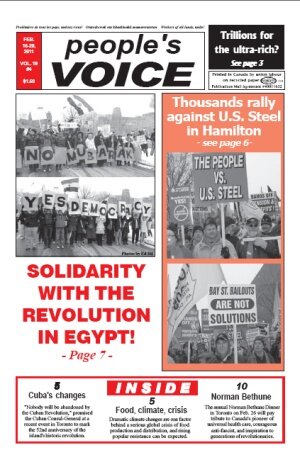
13) SOLIDARITY WITH THE REVOLUTION IN EGYPT!
14) IN SOLIDARITY WITH THE STRUGGLING PEOPLE OF TUNISIA AND EGYPT
15) REMEMBERING THE MASSACRE OF CASSINGA
16) WIKILEAKS ACCUSED BRADLEY MANNING IN EXTREME ISOLATION
17) WHAT’S LEFT
18) CLARTÉ (en français)
19) THE SPARK! (Theoretical and Discussion Bulletin of the Communist Party of Canada)
20) INTRODUCING MARX
21) PV MOBILE
PEOPLE'S VOICE FEBRUARY 15-28, 2011 (pdf)
|
|
|
|
The Spark!The Spark! The latest issue of The Spark! theoretical journal, is now on sale for $5 at Communist Party offices (see p. 8) or People’s Co-op Books, 1391 Commercial Drive, Vancouver. Articles include
plus reviews, editorials, and more.
|
|
|
Theoretical and Discussion Bulletin of the Communist Party of Canada |
|

|
People's Voice deadlines: March 1-15 March 16-31 Send submissions to PV Editorial Office,
|
|
REDS ON THE WEB |
|
People's Voice finds many "Global Class Struggle" reports at the "Labour Start" website, http://www.labourstart.org/. We urge our readers to check it out! |
* * * * *
People's Voice
Canadian Publications Mail Sales Product Agreement #205214
ISSN number 1198-8657
People's Voice is published by
New Labour Press Ltd
PV Editorial Office
706 Clark Drive,
VANCOUVER, B.C. V5L 3J1
Phone:604-255-2041
Fax:604-254-9803
email: pvoice@telus.net
Editor: Kimball Cariou : Business Manager: Sam Hammond
Editorial Board: Kimball Cariou, Miguel Figueroa,
Doug Meggison, Naomi Rankin, Liz Rowley, Jim Sacouman
* * * * * *
Letters
People's Voice welcomes your letters
on any subject covered in our pages.
We reserve the right to edit for length and clarity,
and to refuse to print letters which may be libellous
or which contain unnecessary personal attacks.
Send your views to:
"Letters to the Editor",
706 Clark Dr., Vancouver, BC V5L 3J1,
or mailto:pvoice@telus.net
People's Voice articles may be reprinted without permission,
provided the source is credited.
* * * * * *
The Communist Party of Canada, formed in 1921,
has a proud history of fighting for jobs, equality, peace,
Canadian independence, and socialism.
The CPC does much more than run candidates in elections.
We think the fight against big business and its parties
is a year-round job,
so our members are active across the country,
to build our party and to help strengthen people's movements
on a wide range of issues.
All our policies and leadership
are set democratically by our members.
To find out more about Canada's party of Socialism,
give us a call at the nearest CPC office.
* * * * * *
Central Committee CPC
290A Danforth Ave Toronto, Ont. M4K 1N6
Ph: (416) 469-2446
fax: (416) 469-4063 E-mailmailto:info@cpc-pcp.ca
Parti Communiste du Quebec (section du
Parti communiste du Canada)
5359 Ave du Parc, Montréal, Québec,
H2V 4G9
B.C.Committee CPC
706 Clark Drive, Vancouver, V5L 3J1
Tel: (604) 254-9836
Fax: (604) 254-9803
Edmonton CPC
Box 68112, 70 Bonnie Doon P.O.
Edmonton, AB, T6C 4N6
Tel: (780) 465-7893
Fax: (780)463-0209
Calgary CPC
Unit #1 - 19 Radcliffe Close SE
Calgary AB, T2A 6B2
Tel: (403) 248-6489
Ottawa CPC
Tel: (613) 232-7108
Manitoba Committee
387 Selkirk Ave., Winnipeg, R2W 2M3
Tel/fax: (204) 586-7824
Ontario Ctee. CPC
290A Danforth Ave., Toronto, M4K 1N6
Tel: (416) 469-2446
Hamilton Ctee. CPC
265 Melvin Ave., Apt. 815
Hamilton, ON.
Tel: (905) 548-9586
Atlantic Region CPC
Box 70 Grand Pré, NS, B0P 1M0
Tel/fax: (902) 542-7981
http://www.communist-party.ca/
* * * * * *
News for People, Not for Profits!
Every issue of People's Voice
gives you the latest
on the fightback from coast to coast.
Whether it's the struggle for jobs or peace, resistance to social cuts,
solidarity with Cuba, or workers' struggles around the world,
we've got the news the corporate media won't print.
And we do more than that
- we report and analyze events
from a revolutionary perspective,
helping to build the movements for justice and equality,
and eventually for a socialist Canada.
Read the paper that fights for working people
- on every page, in every issue!
People's Voice
$30 for 1 year
$50 for 2 years
Low-income special rate: $15 for 1-year
Outside Canada $50 for 1 year
Send to: People's Voice, 706 Clark Drive, Vancouver, BC, V5L 3J1
You can call the editorial office at 604-255-2041
REDS ON THE WEB
http://www.communist-party.ca/
http://www.ycl-ljc.ca/
http://www.solidnet.org/
(The following articles are from the Feb. 15-28, 2011, issue of People's Voice, Canada's leading communist newspaper. Articles can be reprinted free if the source is credited. Subscription rates in Canada: $30/year, or $15 low income rate; for U.S. readers - $45 US per year; other overseas readers - $45 US or $50 CDN per year. Send to People's Voice, c/o PV Business Manager, 706 Clark Drive, Vancouver, BC, V5L 3J1.)
1) LEGISLATION THREATENS FREE BARGAINING FOR TRANSIT WORKERS
By Liz Rowley
Mayor Rob Ford and the new right wing majority on Toronto City Council wasted no time at their first meeting in December, passing a motion calling on the province to enact essential services legislation that would eliminate the right to strike for public transit workers. The motion passed with only 17 of 45 members of Council voting against.
The argument made by Ford and his supporters is the standard one: the TTC handles a million riders a day who depend on the system to get them to work and school. These are essential trips for transit riders. Therefore the service should be declared essential, and strikes outlawed.
Many of the 17 argued valiantly, citing the facts that TTC strikes were very few and far between, and were not the cause of any significant disruptions in the last 20 years. The last transit walkout lasted a day and a half over a weekend before the provincial Liberals, with help from the Tories and the NDP, legislated the workers back.
Also, an essential services designation would not prevent work to rule action, and could include work stoppages on weekends and during off‑hours, as occurs in Montreal where the union has lost the right to strike. Further, the cost of arbitrated settlements ‑ such as for police, firefighters and EMS ‑ is significantly higher for the employer over the cost of negotiated settlements, including those negotiated during strikes.
Finally, the right to strike is protected under Canadian law, and the city would have a hard time making the case that transit workers are 'essential' in the same way as police, fire and EMS workers are deemed to be. A transit strike may be inconvenient, but it's not lethal. Removing the right to strike from 10,000 transit workers would shift the balance, leaving the majority of city employees without the right to strike ‑ a historic, precedent‑setting shift.
Local 113 President Kinnear of the Amalgamated Transit Union (ATU) put his finger on it when he said the real crisis in transit is the failure of provincial and federal governments to fund the TTC ‑ the third largest urban transit system in North America, and the one most reliant on the farebox and riders for funding. This chronic underfunding is well‑known to transit riders, after a massive publicity campaign by the previous City Council pointed to the huge shortfalls in funding, most of it promised and defaulted by successive governments.
The 10,000 members of Local 113 ATU, drivers, mechanics, ticket takers, cleaners and so forth, are being targeted to redirect public anger at the system's shortcomings. While attacking the workers and their union, Ford and his Executive went on to cut or reduce service on 67 bus routes, and ditched plans to hire 103 additional TTC staff in 2011, after promising throughout the fall election that there would be no cuts to services in Toronto. Ford also sacked the LRT expansion contained in the city's official transit plan which the province is funding, declaring "the war on the car is over". Bike lanes are also part of the war on cars, according to Ford, and are also under attack.
In early February, three bus drivers were summarily fired for texting or using a cellphone while driving. The union is responding through the collective agreement.
Through all of this, the provincial Liberals have made friendly noises, saying Premier Dalton McGuinty wants to work with the new Council in Toronto. Now the government has indicated that it is preparing legislation to make public transit an essential service. The Hudak Tories ‑ endorsed by Mike Harris ‑ have indicated support, while the NDP has yet to comment. A provincial election is just months away.
Lurch to the right
With back‑to‑back majorities under his belt, McGuinty is feeling the pressure from Hudak (an MPP in the Harris government in the 90s, married to Deb Hutton, a close adviser to the Harris government). The Tories are rising in the polls on the message of opposition to the Harmonized Sales Tax (HST), and tax relief for overloaded 'taxpayers'. Ironic, as ihe Tories and Liberals are colluding to deliver the HST ‑ a value added tax ‑ across Canada, and it's the Tories who are delivering another $6 billion in federal corporate tax cuts this year.
The Tories' message of tax 'relief' is resonating as prices for food, fuel and housing soar, while mass unemployment, under‑employment and insecurity flourish. Along with it comes the fear and anger that propelled Rob Ford to office, and the scapegoating of unionized public sector workers.
There is a very real danger that the essential services legislation will pass, and may go beyond Toronto to cover transit workers across the province. That would set the stage to remove the right to strike for public transit workers all across Canada.
The current collective agreement between the city and Local 113 expires at the end of March. Ford and McGuinty are busy transforming that date into a strike deadline, to push through the no-strike law without public debate.
In an effort to slow things down and force the government to hold public hearings, Local 113's President promised there will be no strike this year. So far ther has been no response from the government. A mass public outcry could sink the Bill, or at least slow it down.
In Toronto, about 60% of city employees would be designated essential if this legislation passes. Only Locals 79 and 416 ‑ inside and outside city workers who hit the bricks for a month in 2009 and were the target of a very ugly media campaign ‑ would still have the right to strike. These 18,000 CUPE members (plus some who have been designated) may be the real target, the last public sector workers with the right to strike in Toronto. It seems likely that the demonization of city workers in the 2009 strike in Toronto, and the earlier four‑month strike in Windsor, were intended to help create a public mood conducive to strike‑breaking in Ontario.
Defend free collective bargaining
The Ontario Federation of Labour, under President Sid Ryan, has launched an energetic campaign to mobilize labour and its allies in defence of workers on strike or locked out by giant national and transnational corporations. Now is the time for labour and its allies to defend public sector workers, including Local 113 ATU on the front line in the struggle for free collective bargaining and the right to strike for all workers.
Strikes can be averted by employers ‑ public and private ‑ willing to sit down and negotiate an agreement. Strikes occur because employers are unwilling to negotiate, because they want cheaper labour or because they want to close up shop, or break the union.
The Communist Party is calling on the labour and democratic movements to oppose the essential services legislation while it's still being drawn up, to demand that it be withdrawn, and to make clear that this issue will cost the Liberals votes in a close election. The Communist Party calls instead for a Bill of Rights for Labour, to guarantee the unfettered right to free collective bargaining, including the right to strike, picket and organize, for all workers.
(Liz Rowley is the leader of the Communist Party‑Ontario)
2) FORD MOVES TO PRIVATIZE GARBAGE COLLECTION
PV Ontario Bureau
TORONTO - Mayor Rob Ford announced Feb. 7 that the City will send out tenders to private companies to bid on garbage collection west of Yonge Street, including parks and other public areas. An estimated 300 jobs will disappear if City Council votes at its May meeting to proceed with the plan. Deputy Mayor Doug Holyday says savings will come through paying much lower wages and benefits.
CUPE Local 416, representing Toronto outside workers, was informed by fax, and also invited to submit a bid. But Local 416 President Mark Ferguson said the move was "a purely ideological attack on the public service."
"Asking us, the union, to bid along (with) private contractors, is an untenable position... We are not an employer, we do not have an ability to manage a workforce, we have no ability to purchase capital equipment," Ferguson said.
Instead the union will start canvassing residents, to explain what privatization would mean to the "super‑service" currently delivered by public employees.
East York also split garbage collection in the '90s and contracted out half the Borough's collection. Residents and businesses complained about poor service until the Borough quietly restored collection to the public sector soon after.
"We are doing this so we're not going to go through another 40‑day garbage strike like we did last year," Mayor Ford said. "We're going to save millions of dollars, and we're going to reduce the size of government."
Contract provisions in the collective agreement make it impossible to contract out collection in the whole city. But that is the goal, and the list for contracting out includes labour-intensive jobs like cleaning police stations and cutting grass.
The city workers' current contract expires Dec. 31, but Mark Ferguson said, "I don't expect that we're going to be taking a strike in January. I think that there's a very real possibility that this administration will lock out its own employees."
Stay tuned.
3) G20 DEFENDANT ALEX HUNDERT RELEASED
After three months in jail without trial, G20 defendant Alex Hundert was released from the Toronto West Detention Centre on January 24th. But Hundert's release came only after he signed a plea bargain with the Crown that he was guilty of being in breach of his "no protest condition" for being present during one portion of a panel at Ryerson University. The plea bargain did not establish that speaking on a panel was equivalent to a public demonstration.
Hundert said, "I made this plea because I realised that I was doing no good to anyone as I sat in jail. There will be no justice in the courts because they exist to protect an unjust and hierarchical order. So I took a deal that would allow me to get back into my community where I can continue to commit myself to issues of social and environmental justice."
Initially arrested in a violent pre‑emptive house raid in June on "conspiracy" charges, Hundert was re‑arrested after being accused of breaching his `no public demonstration' bail condition for speaking at panel discussions at Wilfrid Laurier and Ryerson University in September 2010. Plainclothes officers were present at both events.
Commented Nathalie Des Rosiers, General Counsel at the Canadian Civil Liberties Association, "It seems preposterous to think that public resources, policing and even corrections resources have been spent to prevent someone from attending and speaking at a University seminar. The process was unfair and the charges were exaggerated: it ought not to have happened."
Numerous organizations have condemned the crackdown on dissent before and during the G20 summit, including the Canadian Association of University Teachers, Ontario Confederation of University Faculty Associations, Canadian Union of Postal Workers, BC Civil Liberties Association, and Canadian Union of Public Employees Ontario.
The Ontario Confederation of University Faculty Associations wrote, "This criminalization of legitimate dissent represents an assault on both Mr. Hundert's freedom of expression and the freedom of our universities to foster debate and discussion on issues of public importance. Academic freedom - the ability to engage in controversial or challenging dialogue without fear of reprisal - is a cherished value of Ontario's universities. Such freedom cannot exist when subjected to state surveillance or arbitrary exercise of state power."
David Bleakney, National Union Representative for CUPW, stated, "This travesty is about much more than just Alex however. It is about a legal and political order that promotes the erosion of rights, freedoms, and justice."
The bail condition forbidding participation in public demonstrations is the subject of a constitutional challenge put forward by G20 defendant Jaggi Singh. Out of over 1000 people who were arrested during the G20, only a handful of charges remain. Many arrestees were never charged, and hundreds more have their charges dropped as the abuses perpetrated by the police gain wider public attention.
4) BETRAYAL OF ABORIGINAL WOMEN
People's Voice Editorial
Since about 1980, up to 3000 Indigenous women have gone missing or been murdered in Canada. Indigenous women and their allies are rallying across the country on February 14, a date which has come to symbolize the long struggle against racist, misogynist violence.
In recent years, a leading role in this movement has been played by the Native Women's Association of Canada (NWAC) and their Sisters in Spirit campaign (SIS). Since 2004, this initiative has worked to raise awareness and to gather data about violence against Native women and girls in Canada. By last year, the annual Sisters in Spirit marches and vigils were organized in 86 communities.
Responding to public demands to end this violence, the Harper Tory government's 2010 budget, released last March, promised $10 million to "address the issue of missing and murdered Native women." But then the government held up funding to SIS for eight months. Finally, in November 2010, the Tories announced that this money would not be used to fund SIS research. Instead it will be directed largely towards programs to enhance the power of police forces, operating without the critical tool of solid research and data collection. This betrayal is compounded by the historical antagonism of police forces towards Aboriginal communities; there are many cases of police violence against aboriginal women, such as Gladys Tolley, killed by the Surete du Quebec in 2001.
Aboriginal women refuse to be used for the political advantage of politicians who promise to take action, only to pull the rug out months later. Under the Harper Tories, there has been a consistent racist pattern of dismantling and de-funding programs essential to the safety and health of Aboriginal communities. When thousands of people across Canada take to the streets on Feb. 14, they will demand solutions, not more lies and broken promises.
5) ANOTHER SECRET SELLOUT - Editorial
People's Voice Editorial
Once again, the minority Conservative government ‑ "elected" by barely more than one‑third of voters ‑ has reached a secretive deal which reinforces Canada's integration into the US imperialist empire. The "border security declaration" was signed by Stephen Harper and Barack Obama on Feb. 4 after six months of backroom negotiations involving big business, but not Parliament or the peoples of Canada. The deal includes sharing security information with the US Department of Homeland Security, but little to address the `thickening' of the border which makes it difficult for ordinary people to travel freely.
Stephen Harper calls the deal "a declaration of our relations with the United States," stressing that Canada is the biggest supplier of energy to the United States, and that "any threat to the United States is a threat to Canada." His ominous words recall the origins of the post‑WW2 drive to "continentalism". Imposed by stealth in the early days of the Cold War, the Abbott Plan implemented by the Liberal government of that time sold out any material basis for Canadian economic independence, in favour of the quick profits to be gained by turning Canada into a source of raw materials for U.S. corporations. The subsequent decades have witnessed a huge increase in foreign ownership, the devastating decline of the manufacturing sector, and "trade agreements" which lock into place Canada's role as supplier of energy to our southern neighbour. With this shift has come an ever‑closer alignment of Canada's foreign policy with the dictates of Washington.
Just as frightening, Harper also warns that this declaration is "just a starting point". The implication is that even more dramatic assaults on Canadian sovereignty are on the way. This sellout deal must be blocked, and the Tories must be defeated when Canadians finally head to the polls.
6) PEOPLE'S VOICE FUND DRIVE - A QUESTION OF IDEOLOGY
In our next issue, the annual People's Voice Fund Drive for $50,000 will begin. Our supporters across Canada are making plans for fundraising events, and donations are already trickling in. But first, we'd like to discuss why the working class press is critical in the "battle of ideas."
To paraphrase Karl Marx, the dominant ideology of any society is that of its ruling class. Here in Canada, we live, work, study, play, and consume, immersed in the ideas and values of those who own the huge corporations which control the economy.
This ideology is far from "objective" or "unbiased," despite the claims of the capitalist hierarchy and their political supporters. It's an ideology rooted in the concept that private ownership of natural resources, banks, manufacturing, agriculture, etc., is the "natural" form of human society. This is hardly surprising: in every class-divided society, the owners of wealth present their domination as the normal way of organizing the economy. Under today's capitalism, this includes the idea that the "human imperative" is the individual struggle to achieve success, measured by the critical yardstick of bank accounts, real estate, share capital, mutual funds.
Those who fall short - the vast majority who sell their ability to work - are portrayed as failures, regardless of their contributions to family and community, or to their own class. The locked-out steelworkers in Hamilton, for example, are accused of two supposed "crimes" - failing to become rich enough to retire through their own endeavours, and also being "greedy" for fighting to defend their pension plan from the attack by U.S. Steel.
The ruling class sees its control of the mass media as the most important weapon in the struggle over ideology. This control is usually obscured by claims that the media is "divided" between "liberals" and "conservatives."
On the surface, opposing viewpoints are often found in the corporate media, reflecting differences over social equality issues, for example. Occasionally, voices from the "left" break through, only to disappear. (So long, Rick Salutin, it was good to have you in the Globe and Mail.)
But even these rare voices of dissent are confined within the suffocating boundaries of the dominant ideology of private ownership. One will search in vain for a columnist or commentator who argues for socialized ownership of the capitalist economy, or for working class political power.
Nor is this a coincidence. Recently a reader sent us a help wanted ad, for the position of Editor-in-Chief/Deputy Publisher, "to drive innovation, engagement and revenue across Saskatchewan's leading media brands: The Saskatoon Star-Phoenix and Leader-Post (Regina)." The successful applicant will "be responsible for all content, quality of content, and product initiatives" and "work closely with the brands' respective advertising and marketing departments" etc.
This job description illustrates the complete grip of ruling class ideology on the mass media. The era when crusading editors hired reporters for their writing skills and knowledge of key issues is ancient history, to the extent that it ever existed. In the modern era, media outlets are "brands" operated by editors and publishers employed for their willingness to please the corporate master, hiring "journalists" churned out by post-secondary institutions which teach the same capitalist values.
Some "democratic media" activists argue that the Internet makes it possible for ordinary people and progressive movements to break the chains of capitalist information control. And there is some truth to this argument. A wider range of media outlets does encourage greater diversity of opinions and analysis.
But this alone does not challenge the basic problem of ruling class ideological domination. People's Voice is vital for the working class movement, not because we are the only "alternative" source of news (we aren't), but because we use the facts to make the case for socialist ideology, for working class political power, for a world free from imperialism. When we ask for support, keep this in mind, and be as generous as possible!
7) BETHUNE: LEGENDARY CANADIAN COMMUNIST
We continue our series of articles honouring the 90th anniversary of the Communist Party of Canada with the story of Norman Bethune.
The most legendary Canadian communist is undoubtedly Norman Bethune: brilliant medical pioneer, early campaigner for universal health care, writer, and passionate anti-fascist. His colourful life has been the subject of countless books, articles, plays and films, and he was immortalized in a famous essay by Mao Zedong.
To this day, Bethune's personality is relentlessly analyzed by some who downplay his revolutionary essence. A recent biography by former governor-general Adrienne Clarkson, for example, tries to explain Norman Bethune's political outlook as a reflection of his religious family origins, not a logical response to the horrors of capitalist war and injustice.
Born in Gravenhurst, Ontario on March 3, 1890, Bethune was one of three children of a Presbyterian minister. He graduated from Owen Sound Collegiate, and enrolled in medicine at the University of Toronto in 1909. His studies were interrupted in 1911, when he became a labourer-teacher with Frontier College, holding literacy classes for immigrant mine labourers in northern Ontario.
Like many of his generation, Bethune volunteered when World War One broke out, only to witness the horror of imperialist slaughter on the battlefields of Europe. As a stretcher‑bearer in France, he was wounded by shrapnel, and returned home to complete his medical degree. In 1917 he joined the Royal Navy as a Surgeon-Lieutenant at the Chatham Hospital in England. After the war, he became a specialist at The Hospital for Sick Children in London, and then furthered his qualifications at the Royal College of Surgeons in Edinburgh.
He married heiress Frances Penny in 1923, and the couple eventually moved to Detroit, where he began private practice and a part‑time job as a medical instructor. Contracting tuberculosis due to overwork and close contact with the sick, Bethune sought treatment at the Trudeau Sanatorium in Saranac Lake, New York. There he researched a controversial new treatment, which involved artificially collapsing the tubercular lung, allowing it to rest and heal. The operation was a success, and he made a full recovery. But the experience helped to confirm his radical views on disease and medicine under capitalism.
In 1929 Bethune joined the thoracic surgical pioneer, Dr. Edward William Archibald, at the Royal Victoria Hospital in Montreal. From 1929 to 1936 he perfected his skills, developed or modified more than a dozen new surgical tools, and published 14 articles describing his innovations in thoracic technique.
At the same time, he became deeply involved with social and economic issues, providing free medical care for the poor, and art classes for children. He formed the Montreal Group for the Security of People's Health, and in 1935 he visited the Soviet Union to observe the socialist system of free public health care. During that same year, he joined the Communist Party of Canada.
When the Spanish Civil War began in 1936, he accepted an invitation to head the Canadian Medical Unit in Madrid, linked with the Mackenzie‑Papineau Battalion of Canadian anti-fascist fighters. Faced with sudden battlefield deaths caused by loss of blood, Bethune conceived the idea of on-site transfusions, and developed the world's first mobile blood-transfusion unit. He returned to Canada in June 1937, embarking on a cross-country tour to raise money and volunteers for the struggle for democracy in Spain.
As the global fascist threat deepened, Bethune travelled in 1938 to China, to join the Communists led by Mao Zedong fighting the Japanese invaders. He immediately begin to organize medical services for the military front and the region. He performed emergency operations on war casualties, and established training for doctors, nurses and orderlies, treating wounded Japanese prisoners as well as Chinese.
In the summer of 1939 Bethune was appointed Medical Advisor to the Jin‑Zha‑Ji (Shanxi‑Chahar‑Hebei) Border Region Military District, liberated by the Communist Party of China's Eighth Route Army. A few months later, Bethune cut his finger while operating on a soldier. Probably due to his weakened state, he contracted blood poisoning, and died of his wounds on November 12, 1939.
Bethune received international recognition when Chairman Mao Zedong of the People's Republic of China published his essay "In Memory of Norman Bethune", which documented the final months of the doctor's life. The essay became required reading in China's schools. Statues dedicated to Bethune's honour have been erected throughout China, and he is buried in the Revolutionary Martyrs' Cemetery, Shijiazhuang, Hebei Province.
There have been many other forms of official recognition. Bethune College at York University, and Dr. Norman Bethune Collegiate Institute in Scarborough, Ontario, are named after him. In 1976, the manse in Gravenhurst where he was born was restored as Bethune Memorial House, a National Historic Site. In 1998, Bethune was inducted into the Canadian Medical Hall of Fame, and his statue stands in a public square near Montreal's Guy-Concordia Metro station. In 2006, Spain opened the Walk of Canadians in Malaga, paying tribute to Bethune and his colleagues who helped the population of that city during the Spanish Civil War.
Bethune was the subject of a 1964 National Film Board documentary, directed by Donald Brittain. Donald Sutherland played Bethune in two films, including Bethune: The Making of a Hero (1990), based on the 1952 biography The Scalpel, The Sword, by Ted Allan and Sydney Gordon. In the CBC's Greatest Canadian program in 2004, he was voted the 26th Greatest Canadian by viewers.
Towering over those who would trivialize his tumultuous life, Norman Bethune is recognized around the world as a revolutionary martyr, whose courage and dedication to the goals of socialism have inspired generations in the struggle for a better world.
8) YOUTH FESTIVAL: A LESSON IN PEACE AND SOLIDARITY
Last December, the 17th World Festival of Youth and Students took place in South Africa. 15,000 youth from over 120 countries came together for conferences, sports, music, and politics under the slogan of "Let's defeat imperialism: for peace, solidarity and social transformation!". The previous issue of People's Voice reported on the Festival and social transformation in Africa. Here, Johan Boyden looks at peace and solidarity, and the experience of the All‑Canada delegation.
Forty delegates
Technically, we were one person under the number forty. But forty sounds better than thirty‑nine. The delegates came from a wide range of backgrounds: students and young workers, trade unionists and experienced activists, people fairly new to left politics, from 17 to just over 30. They came from across the country, Vancouver, Edmonton, Winnipeg, Ontario, Halifax and a National Quebec committee.
For some, this was their first‑time working closely with Quebec youth activists, in an environment where every group meeting slowed down for translation. A few delegates had lived on the street. Several were unemployed, or carrying heavy student debts. Some had fundraised for six months to get their plane ticket. For all but one, it was our first time in Africa. These are some of our stories.
Biased to the working class
Pat is from Toronto. He was sent to the Festival from his local, CUPE 416. I remember Pat's steward at the first meeting of the Toronto festival committee.
"We want Pat to bring back all the experience of the youths in South Africa, and bring it back here to the youth committee," he said. "All the internationalism." Local 416 represents 'outside' city workers. Some collect the city's garbage. Pat works in parking. They are the 'bad boys' in the media for going on strike a few years ago. Now with right‑wing Mayor Rob Ford, the union is under attack again.
I called up Pat last month. One of his highlights of the Festival actually occurred the day after the closing ceremony. Several trade union delegates met with a representative of the Congress of South African Trade Unions, COSATU. They talked for hours about solidarity, the labour movement in South Africa, the situation in their countries. The next day, the comrade from COSATU (in South Africa, everyone in the movement is a comrade) took them on a tour of Gauteng Province, scene of major strikes in the past year.
"I missed that tour because I had to fly out," Pat tells me. He talks instead about a slogan of one of the public sector unions. He plans to mention it in his report‑back to the Toronto and York Region Labour Council: "making the public sector biased towards the working class."
"I like that one," he says.
Solidarity & internationalism
What is internationalism? Is it visits, friendship, exchange of ideas, like the strategy and tactics of the working class? Is it expressions of support for peoples of other countries? Perhaps symbolic support, like a picket outside the Colombian consulate. Or direct action, like dock workers refusing to unload Israeli ships during "operation cast lead" and the 2008 war on Gaza (In a bilateral, we told members of the Palestinian delegation about the Boycott, Divestment, Sanctions campaign in Canada. "This is very good" they said).
Is globalization internationalism? Is it Coca‑cola, Mickey‑mouse, Disneyland in Japan, the hard boots of NATO troops marching into Afghani villages?
The question came up at the Festival, at a discussion where I simply listened. I was reminded of that discussion the other day. Two friends were munching down dinner at our home. We tend to think of globalization as exclusively negative ‑ the violent cancer of capitalist imperialism. At the table, there was debate. "But what about globalization is positive?" "Well, would you say we should get rid of the internet?" another said.
Of course, globalization is more than the paradox of the internet. As I write today, all internet service providers in Egypt are shut down. Within globalization are contradictions, just like within capitalism itself, the system which brings working people together to produce, yet whisks away the result into the private pockets of the capitalist class.
The octopus‑style expansion of world markets, driven by profits, creates a new and diverse force in the world, the working class on a global level. So we might re‑write the slogan that inspired Pat. We might say: "Making the public sector biased towards the vast majority of the world, the people on the side of justice, peace and progress, and the future."
But that would defeat the purpose of slogans, to concisely place a fiery idea.
Unscripted friendship
Capital, Marx said, is born "dripping from head to foot, from every pore, with blood and dirt." So too is globalization inseparable from imperialist war. What about this question: can we create the conditions for peace? A cynic might deny any hope. Most folks focus on step one: defeating imperialism, the economic basis of war. But even if we can do that, can we find friendship in the world?
I found one answer in the stories of Denise, a student from Guelph. I was looking at a photo on Facebook. The image is actually more a dark blur. Faces and arms and a few feet, bodies dancing. The picture is broken by a wide ray of light, cast down over the field. The photo was taken behind the Tshwane University Trade School residences, in a large open field.
Denise seems to go everywhere with a camera. For taking a left-wing position on her student union, she has come under a lot of attack. But it wasn't the formal student discussions she first told me about. It was the parties, like the one in the photo.
The Cubans brought many things. First: people! (Speaking to one of their delegation leaders, I realized this was not his first time in Africa. Having served as a volunteer in the liberation of Angola, he was now a doctor.) The Cubans also brought art and photographs of their socialist island ‑ and a giant banner as long as a building, calling to free the Cuban Five from US jails.
"They Cubans also brought their own band," Denise said. "It played rock one moment then salsa the next. It was a strange mix, but very good." People kept talking about the `Brazilian Party,' she said "but there really were no Brazilians. It seemed to be people from everywhere. Then on the last night I spent time with more [Latin Americans]. We just sung songs all night, all the songs of their revolutions and struggles."
The parties were about a good time, a short glimpse, a free-form exchange, about culture and life. They were part of thread that ran through the Festival of music, dance and singing. Just search the Festival's name on Youtube or Daily motion.
In one Canadian delegate's video (not published yet) you see a sort of spontaneous, at first cautious and then increasingly informal interaction with delegates from a member of the "axis of evil," the DPR of Korea. With the history of war between our countries, you might expect anger and resentment from the Korean side. Instead we learned that while, as one delegate said, "they're not too big on handshakes," the Koreans can sign beautifully, as well as laugh, smile, yawn, and frown like us ‑ in short, that they are human.
The Solomon Song
Perhaps the most powerful songs of the Festival were the anti‑apartheid struggle chants. The smash hit, the anthem of the Festival was the Solomon song. First you would hear the song. Then the singers would appear ‑ chanting, stomping feet, twenty South African youth. It was in a language we did not understand, but with bold, rich and loud voices that immediately caught our attention, proclaiming with fists in the air: "Iyho uSolomon. Iyho uSolomon. Iyho uSolomon! Iyho uSolomon!"
More South African youth would come out of the buildings, drawn by the music, and join the stomping singers. Everyone's arms would be outstretched. Another twenty youths, then fifty to a hundred people began to move: "Isotsha lo Mkhonto We Sizwe! Wa yo bulala amabhunu eAfrika!"
In only a few days, members of the Canadian delegation would be singing the Zulu words, proudly chanting and stomping with the a cappella singers. Later we would find translations, and discover the lyrics' political meaning. Most of the South African delegates were not singing in their first language, but the political meaning was still communicated.
The translation I wrote down was: "Solomon, Oh Solomon. He was the spear of the nation (referring to the former armed wing of the African National Congress, Umkhonto we Sizwe, "MK"). He struggled for liberation of Africa."
Our delegation has video and audio recordings of the song from the beginning and the end of the Festival. In the opening ceremonies, delegates look genuinely surprised and confused at people's energy in delivering lyrics. By the end, groups of youth from Asia, the Middle East, the Americas, and Africa all run along together, singing the words in their own languages.
Solomon was actually a real person, a young ANC‑MK militant sentenced to death. For two years the international democratic community campaigned against his execution and called for the recognition of all South African freedom fighters as prisoners of war. Then on April 6, 1979, 23 year old Solomon Mahlangu was hung by the racist regime.
Solomon's final words are reputed to have been: "My blood will nourish the tree that will bear the fruits of freedom. Tell my people that I love them. They must continue the fight."
Continuing the fight
You can read Solomon's words on the ANC website. But I heard them first from another Quebec delegate, recounting her experiences of that day. "No justice, no peace," somebody said. We laughed. But peace must blossom out of solidarity and friendship, out of a basic respect and tolerance, out of justice and struggle.
As the delegate told her stories, not every experience had been positive. Like other women delegates she had experienced sexual harassment by some other delegates. It was more than just an individual experience. There was a sense of betrayal of the Festival's spirit, the aspiration that ‑ despite the differences of the women and men of the world in language, culture, beliefs, experience, nationality, and so many other qualities ‑ those amongst the majority, toiling in fields or cities, can find a mutual common ground, craft a different destiny.
In this sense, even within the progressive forces we have much work to do, like on the question of sexism and women's struggles, mentioned in Festival's final declaration. A main place for that work is the broader struggle itself.
Internationalize resistance
From international campaigns, actions, revolutions, we can take inspiration. Youth, students, and working people can also learn. We can pick up the flag of resistance against "our" own government, and its foreign policies of plunder, economic blackmail, murder and ecocide, free trade deals, blockades, sanctions, interference, aggression and war.
Such resistance is internationalism in its fullest sense. It is inseparable with the desire to overthrow imperialism, to defeat its governments and ruling class forces behind them, and to win peace, friendship and solidarity. In a way, it was the call of the Festival for the youth to carry forward, with confidence in our path.
9) NATO OCCUPATION BOGGED DOWN IN FAILURE
PV Commentary
Mounting civilian deaths in Afghanistan, and revelations about the dirty role of Canada's hired guns in the NATO-occupied country, have boosted the demand for immediate withdrawal of Canadian troops. Despite the Harper government's arbitrary decision to extend the Canadian mission by three more years - disguised as a re-configured "training" role - the majority of Canadians still favour an early end to the military involvement which began a decade ago. Since then, the mission has cost Canadian taxpayers an estimated $20 billion, almost entirely for military purposes rather than building civilian infrastructure. Over 150 Canadian troops have been killed, and thousands of Afghans die under the occupation every year.
At least 2,421 civilians were killed last year, according to a new report released on Feb. 1 by the Kabul‑based Afghan Rights Monitor. More than 3,270 civilians were also injured in "conflict-related security incidents."
The report blamed "armed opposition groups" for 63 percent of the civilian deaths, many caused by "improvised explosive devices", such as road bombs targetting occupation troops. U.S.‑NATO forces account for another 21 percent of deaths, or nearly 500. The NATO forces, said the report, wrongly continue to label almost every war casualty as being a "suspected insurgent." A total of 499 U.S. troops and 212 other coalition members were killed in Afghanistan in 2010.
Meanwhile, a report from the U.S. Government Accountability Office showed that despite an increase in the size of the Afghan National Army (ANA), levels of violence are on a steady upward trajectory. The GAO found that as of September 2010, not a single ANA unit was considered as capable of carrying out its mission independent of NATO assistance. Two‑thirds were "effective with limited coalition support."
A Canadian Press report says that "Canada spent more than $41 million on hired guns in Afghanistan over four years, much of it going to security companies slammed by the U.S. Senate for having warlords on the payroll. Both the Defence and Foreign Affairs departments have employed 11 security contractors in Kabul and Kandahar since 2006, but have kept quiet about the details."
Documents tabled in Parliament at the request of the NDP show Foreign Affairs paid nearly $8 million to ArmorGroup Securities Ltd. This company was cited in a U.S. Senate investigation as relying on Afghan warlords who in 2007 were engaged in "murder, kidnapping, bribery and anti‑Coalition activities." The company provided security around the Canadian embassy in Kabul and guarded diplomats.
The situation is "appalling," said NDP foreign‑affairs critic Paul Dewar. "It undermines our credibility. Afghans are not stupid. They see these people. They see what they're doing and they know who is paying them... We've spent tens of millions of dollars on what I would consider to be some very dubious characters, to do what? Foreign Affairs, in particular, needs to be held to account. I'm blown away by what I'm seeing here."
Canadian Press quotes defence researcher Dave Perry, who claims that such contractors, usually ex-soldiers, are a "fact of life in the age of all‑volunteer armies." Perry's response simply confirms that Canada's overall military present in Afghanistan is larger than the government's claims.
Last fall, President Karzai ordered the estimated 40,000 armed security contractors to leave the country, but later backed down. Instead, his government has demanded that such firms register and begin paying taxes.
With a possible election looming, NDP leader Jack Layton has been critical of the plan to redeploy Canadian troops to build up Afghanistan's army. The move will end up training Taliban insurgents, Layton said recently, pledging to campaign for NATO troops to come home, and arguing that the entire military effort is destabilizing Afghanistan. Instead, he called for an increase in diplomatic efforts and a "massive civilian deployment" of development aid. Layton's position marks a shift from the past three years, when he repeatedly emphasized the "courage and sacrifice" of Canadian Forces.
Michael Ignatieff's Liberals, who gave cover for Harper's troop extension, argue that it is impossible to achieve Layton's plan "in the midst of conflict without providing Afghans with the tools to protect their security and their democracy."
As the parliamentary parties point fingers, it is clear that the Canadian military mission has done nothing to make Afghanistan safer or more democratic, and the NATO mission cannot achieve its stated goals. Instead, the latest reports prove that the anti-war movement has been correct from the beginning. The invasion was a tragedy which has cost hundreds of billions of dollars and countless lives, and the imperialist occupation remains bogged down in utter failure.
10) BEHIND THE UPRISINGS - A GLOBAL FOOD CRISIS
By Kimball Cariou
The uprisings shaking the Arab countries in recent weeks are not directed simply against dictatorial elites - they are largely a response to deepening poverty and the growing gap between rich and poor. In one sense, these revolts are a continuation of the huge general strikes which rolled across Europe during 2010. Tunisia's large trade union movement played a critical role in the successful struggle against the dictator Ben Ali, a signal that the working class will be the key element in wider global resistance to the neoliberal agenda imposed by big capital.
One of the sparks for the Arab revolts has been hunger and rising prices, which reflect the emergence of a serious world-wide food crisis. As angry demonstrators wave loaves of bread, fearful politicians take timid steps to respond, such as reversing their cuts to subsidies of vital foodstuffs.
In one of his recent "Reflections," Cuba's former president Fidel Castro located this crisis in a wider context: "The problems have suddenly increased as a result of phenomena which are being repeated on all continents: heat waves, forest fires, loss of harvests in Russia, with many victims; climate change in China, heavy rainfall or drought; progressive reduction of water reserves in the Himalayas which is threatening India, China, Pakistan and other countries; torrential rain in Australia, which has flooded almost one million square kilometers; unseasonable and unprecedented cold in Europe ... drought in Canada and unusual cold in this country and the United States..."
Fidel Castro warned that "production of wheat, soy beans, corn, rice and many other grains and legumes, which constitute the nutritional base of the world - the population of which (is) rapidly approaching the unprecedented figure of seven billion and where more than one billion are suffering hunger and malnutrition - is being seriously affected by climate change, creating an extremely grave problem worldwide."
He also points to a recent article by Lester R. Brown, published on the Organic Way website. Brown notes that the price of wheat is setting an all‑time high, at a time when the world's population is growing by 80 million people each year, or 219,000 every day. While consumption of meat, milk, and eggs in fast-growing developing countries keeps growing, many are going hungry.
Meanwhile, the United States harvested 416 million tons of grain in 2009, of which 119 million tons went to ethanol distilleries to produce fuel for cars - enough to feed 350 million people for a year. Most of the huge global jump in grain production is due to expansion of ethanol distilleries in the United States.
In Europe, there is growing demand for plant-based diesel oil, principally from rapeseed and palm oil. This is reducing the land available to produce food crops in Europe, and driving the clearing of rainforests in Indonesia and Malaysia for palm oil plantations.
At the same time, new constraints are emerging on the supply side. An estimated one third of the world's cropland is losing topsoil faster than new soil is forming through natural processes. Huge dust bowls are forming, one across northwest China, western Mongolia, and central Asia; the other in central Africa. Satellite images show a steady flow of dust storms carrying off millions of tons of precious topsoil.
Aquifer depletion is shrinking the amount of irrigated area in many regions, driven by the large‑scale use of mechanical pumps to exploit underground water. Today, half the world's people live in countries where water tables are falling. Irrigated area is shrinking across the Middle East; in Saudi Arabia, which was totally dependent on water aquifers, wheat production plummeted by two-thirds from 2007 to 2010.
The biggest water deficits are in India, where the World Bank reports that 175 million people are fed with grain produced by overpumping. In China, overpumping provides food for some 130 million people. In the United States, irrigated area is shrinking in key agricultural states such as California and Texas.
Rising temperatures will also make it more difficult to expand the world grain harvest. Crop ecologists warn that for each 1 degree Celsius rise above the optimum during the growing season, a ten percent decline in grain yields will result.
The melting of glaciers in the Himalayas and on the Tibetan plateau will impact the major rivers of Asia during the dry season - the Indus, Ganges, Mekong, Yangtze, and Yellow rivers - and also the irrigation systems dependent on these rivers.
Brown warns that "the unrest of these past few weeks is just the beginning. It is no longer a conflict between heavily armed superpowers, but rather spreading food shortages and rising food prices ‑ and the political turmoil this would lead to ‑ that threatens our global future. Unless governments quickly redefine security and shift expenditures from military uses to investing in climate change mitigation, water efficiency, soil conservation, and population stabilization, the world will in all likelihood be facing a future with both more climate instability and food price volatility. If business as usual continues, food prices will only trend upward."
We have been warned. The world can no longer afford "business as usual", i.e. an imperialist system based on maximizing profits and wealth for a tiny corporate elite. The militant actions by the people of the Arab countries and the working class of Europe point the way to survival - a socialist economic system based on meeting the needs of the people and the environment.
11) NO ONE WILL BE ABANDONED BY THE CUBAN REVOLUTION
Excerpts from a Jan. 26 speech by Jorge Soberon, Consul‑General of Cuba in Toronto. Soberon spoke at a celebration of the 52nd anniversary of the triumph of the Cuban Revolution, organized by the Latin American and Caribbean Solidarity Network and the Cuban Consulate in Toronto.
The triumph and the existence of the Cuban Revolution, is also a triumph for Latin America and the Caribbean and of the friends of Cuba throughout the world.
Much has been the sacrifice of the Cuban people since it began its struggle more than 140 years ago, on October 10, 1868. Cuba has shown that, despite all obstacles, government of the humble, by the humble and for the humble is still possible. Cuba has nothing to hide and nothing to be ashamed of.
To those who relentlessly criticize the Cuban revolution, we say: The Cuban Revolution has never condoned or practised torture, disappearances or extrajudicial killings, secret prisons have never existed in the Cuban Revolution, nor has it used repression against the people. In Cuba the law has never been applied without a proper trial and Cuba has been an example of justice when it has been necessary to apply the more severe penalties.
Only because of the Cuban Revolution there are today more than a thousand doctors sent by Cuba in Haiti saving lives in that noble and brotherly people.
Only because of the Cuban Revolution 50,000 foreign students have graduated in Cuba since the triumph of the Revolution.
Only because of the Cuban Revolution, 45,000 Cuban doctors and technical workers have given their services in the more remote regions of the world.
Only because of the Cuban Revolution millions of compatriots in our region and in various parts of the world had been able to recover their vision or be literate with the help of Cuban doctors and collaborators.
Only because of the Cuban Revolution, Cuba helped other sister nations to be free from colonial yoke, from apartheid and to and achieve independence.
Only because of the Cuban Revolution, the Cuban people has access to education and free medical care, employment opportunities for all, access to culture and sport, and has achieved high levels of human development.
Imperialism and neoliberal market rules have nothing to offer the people of Cuba, except slavery.
Only the joint work with sister nations, as the ALBA alliance, the free development of relations with the rest of the world's peoples and the ability to resist, fight and develop in socialism, can ensure our people the welfare it wants and deserve.
Cuba faces the difficulties inherent of a developing country with limited resources and subjected to a strict sanctions regime and the hostile policy of the most powerful nation ever.
There have been many obstacles that our people have had to overcome and still face, but for more than 50 years we have been able to hold high the banner of socialism and social justice, just 90 miles from the United States.
The economic sanctions and political meddling of the United States in Cuban internal affairs is still valid today, causing severe human and economic damage. It must cease immediately without imposing any conditions to Cuba...
Cuba today is making strategic changes in its economy and society to build its socialism, not to destroy it. No one has ever been or will be abandoned to their fate by the Cuban Revolution. Cuba will not drop its social achievements, knowing that only with socialism it can guarantee its independence and sovereignty. Cuba will never renounce its disinterested cooperation with the peoples of the world.
The younger generations are already assuming the continuity of the socialist revolution. The Revolution has been, is and will be the work of the youth. Young Cubans were the ones who fought for the freedom of other peoples of the world, young Cubans are the ones who collaborate today as doctors and technicians abroad and young people are our five heroes imprisoned in the United States...
Imperialism is still dreaming and working to destroy the Cuban Revolution. They will never defeat the Cuban Revolution with their paid mercenaries. In Cuba we look forward with confidence, certain that the future belongs to those who do not stop fighting and work tirelessly for a better future.
That is our conviction on a day like today, when we appreciate the support of all our friends in Canada and around the world. Today we celebrate the victory of the humble, of justice and independence that is ultimately the Cuban Revolution.
Long live the peoples struggling for justice and independence! Long live the Latin America and the Caribbean of Bolivar and Marti! Long live the Cuban Revolution!
12) THE MOMENT OF TRUTH IS APPROACHING
Statement issued by the Communist Party of Egypt, Cairo, Feb. 1, 2011
The moment of truth is approaching. This is the decisive moment for the Egyptian popular forces for change; to topple the Mubarak regime. It seems that the imperialists, and their American masters in particular, are lifting their hands from him after the continuation of revolution everywhere in Egypt.
Today millions emerge to demand the departure of Mubarak. They will prevent all the conspiracies of the dictator and his gang of spies to thwart the revolution and overcome them.
The formation of a committee, which enjoys the confidence of the people and the demonstrators, is crucial to achieve the demands of the political, economic and social revolution, and we emphasise the basic demands presented by the national forces to the deputies of the people's parliament:
1. Dismissal of Mubarak and the formation of a presidential council for a transitional period of limited duration.
2. Forming a coalition government to administer the country during the transitional period.
3. To convene the election of a constituent assembly to draft a new constitution for the country based on the principle of the sovereignty of the nation and ensure the devolution of power within the framework of a democratic just civil state.
4. Prosecute those responsible for hundreds of deaths and injuries of revolutionary martyrs and victims of oppression as well as ensuring the prosecution of those responsible for plundering the wealth of the Egyptian people.
5. Long live the revolution of the Egyptian people!
13) SOLIDARITY WITH THE REVOLUTION IN EGYPT!
Statement of the Central Executive Committee, Communist Party of Canada, Feb. 3, 2011
The massive popular and peaceful uprising against the dictatorial regime of Hosni Mubarak, which has captured the world's attention over the past ten days, continues to expand and deepen despite the desperate attempts of the Egyptian ruling class and its imperialist backers to douse the flames of revolution. After 30 long years of oppression, grinding poverty and corrupt rule, millions of working people have held unprecedented mobilizations day after day in the streets of cities and towns across Egypt, around the unifying demand that Mubarak and his government cronies and thugs must immediately resign, and that new genuinely fair and democratic elections be held.
Aroused by the inspiring "intifada of the poor" in nearby Tunisia which recently deposed the dictatorship of Zain Al-Abidin Bin Ali, the Egyptian masses are determined that "Mubarak must GO!" While the popular rallying cry is for an end to oppression and for real democratic rule, the underpinnings of the revolutionary upsurge are rooted in the social and economic grievances of the working class, which has endured high unemployment, rising food prices and impoverishment - further heightened during the recent global economic crisis - while the ruling class elite and their flunkies in the Mubarak regime accumulate the national wealth produced by their labour.
The transparent manoeuvres of Mubarak to cling to power have failed miserably to stem the tide. First, he announced a cosmetic cabinet shuffle, elevating Omar Suleiman to the vice‑presidency. Suleiman, the former chief of Egypt's notorious intelligence branch, is best known for his role as CIA point‑man, organizing rendition flights and torture at the behest of Washington's so‑called "war on terror". Later, the dictator pledged to serve out his term (until September 2011) before stepping down, hoping that a delay would allow him time to regroup his shattered forces. But the Egyptian people have rejected these false promises and "compromises" overwhelmingly. Finally, the regime has resorted to violence, unleashing thugs (mostly plainclothes cops and members of his discredited National Democratic party masquerading as "pro‑Mubarak" supporters) to attack the peaceful and unarmed protests in Tahrir square in Cairo, in Alexandria, Suez and elsewhere. But the people have held firm against this counter‑revolutionary violence, despite an escalating toll of death and injuries.
The role of the imperialist powers, including Canada, in this crisis has been two‑faced and despicable. While Washington, London and Ottawa have been forced to publicly recognize the legitimate popular resentment against the hated regime, and to pose as defenders of "democracy" and the "right of peaceful dissent", they are feverishly working behind the scenes to prop up their interests in the region. While Mubarak himself is expendable, U.S. imperialism and its allies worry that the burgeoning movement will develop into a full‑fledged national democratic and anti‑imperialist revolution, and may spread to other parts of the Arab world, threatening the reign of other client regimes and undermining US‑Israeli hegemony in the region as a whole.
The Communist Party of Canada expresses its wholehearted solidarity with the heroic revolutionary process unfolding in Egypt today, and urges all its members and supporters, and all democratic‑minded and anti‑imperialist Canadians to rally in support of the Egyptian people in demonstrations taking across Canada. We condemn the failure of the Harper government to publicly and sincerely condemn the Mubarak regime, and demand a complete reversal in Ottawa's foreign policy, to stand in favour of the struggling Egyptian people, beginning with the expulsion of the Egyptian ambassador to Canada in response to Mubarak's state-organized violence against his own people.
14) IN SOLIDARITY WITH THE STRUGGLING PEOPLE OF TUNISIA AND EGYPT
South African Communist Party statement on the developments in Egypt and Tunisia, Feb.2, 2011
The South African Communist Party (SACP) welcomes the political revolts and developments in Egypt and Tunisia and elsewhere, and strongly condemns the brutal responses by the collapsing regimes of dictators; in the case of Egypt we appreciate the restraint of the military force.
These developments increasingly point out the correctness of our party's shared strategic analysis with many of the forces in the Africa Left Networking Forum: "the crisis facing Africa, including Tunisia and Egypt, remains its deepening marginalisation and impoverishment within the global imperialist system, the failure over many decades of a variety of elite‑based neo‑colonial agendas on the one hand, and the degeneration and in several cases, the collapse of more radical national democratic revolutions led by former liberation movements on the other".
We observed that "at the heart of revitalising the African revolution (part of which is currently underway in Tunisia and Egypt) is the task of creating the conditions (i.e. the social, economic, democratic, and organisational space and capacity) for the key national democratic protagonists - the working class, the peasantry, the mass of urban and rural marginalized (many of them youth), together with patriotic middle strata in the state and civil society - to become the key motive force of re-radicalisation, not just in theory but in practice".
It is imperative therefore as part of this ongoing class analysis, that we fully support the popular aspirations of the people of Tunisia and Egypt to seize power by mobilising progressive strata, students, youth, women, in alliance with working people against the reactionary dictatorial state, to support its complete revolutionary overthrow and the transformation process towards broad social, political and economic change.
Whilst much of the analysis of these developments is reductionist and not located in the long range, strategic class character of Tunisian and Egyptian societies, it is important to appreciate these developments as being uniquely shaped by objective historical factors in the generalised crisis of development over many years.
The origin of the Egyptian crisis ‑ the absence of popular democracy and participation for instance ‑ can be traced back decades ago, from right wing public policies in the social, political and economic domain, in which many of the sovereign political and economic functions were completely abandoned by the state to the service of bourgeois ideological forces backed by imperialism.
Our party also welcomes the massive strategic backlash suffered by the neo‑liberal character of media reportage on these developments, in which opportunistic consensus by a promotional lining‑up of capitalist oriented successors is forged from the back door.
These agendas must be defeated by increasing the tempo of alternative reporting, which thus far has provided a much sober description, that what the people of Egypt and Tunisia are demanding, constitutes not a neo‑liberal stabilisation, but a complete rupture with dictatorships, in which people insist on complete over‑haul of the ruling capitalist class and its machinery.
We should remain alert to the mechanisation of imperialist forces to propel such revolts only to spill the victory, like they did in some of the areas in the former Soviet states which today yearn for the socialist system.
The SACP also notes that these revolutions are not immune from reversal and counter‑revolutionary ambitions, in which they can be subverted and turned into sectoral mobilisation for reactionary ends. It is thus important that the revolutionary tasks of current social, political and economic mobilisation, goes far beyond tinkering with the superficial, but addresses the class character of the current states and its apparatus.
Central to these revolutions is the dismantling of the repressive machinery of the Tunisian and Egyptian state and forging a unifying strategic platform to address popular aspirations of the working people, by transforming political power, meeting people's basic needs for quality jobs, food, shelter, to defend workers, women struggles and the rights of young people to education and decent jobs.
Our party will also join in on solidarity demonstrations and continue the debate on the character of these revolutions.
15) REMEMBERING THE MASSACRE OF CASSINGA
By Stephen Von Sychowski
Cuba is known around the world for its feats of international solidarity. Today it is a sort of medical super-power, sending doctors across the globe to help those in need. But during the struggle against colonialism and apartheid in Africa, Cuba played one of the most prominent roles of any non‑African country on the side of freedom and national liberation.
Unfortunately it is not common knowledge that while the United States backed racist South Africa, Cuba sent tens of thousands of volunteers, as well as tanks, artillery, and other military hardware to aid the liberation armies.
The best known battle is that of Cuito Cuanavale, where 95,000 Cubans joined with Angolan troops and Namibian SWAPO guerillas to smash a 1987-88 offensive against independent Angola by the South African Defense Force (SADF) and their US‑backed UNITA allies.
But 33 years ago, in a lesser‑known altercation, Cuba helped to stop a brutal massacre of men, women, and children by the South African Defense Force in the southern Angolan town of Cassinga.
Cassinga was the site of a refugee camp, established by the Namibian South West African People's Organization (SWAPO). On May 4, 1978, it came under airborne attack and bombing from South African planes. Paratroopers quickly overran the surprised SWAPO troops, leaving hundreds of civilian refugees defenseless.
The Cubans were stationed nearby at Techamutete. When news of the attack reached them, they immediately set off to engage the aggressors. When the South Africans intercepted news of the Cuban advance, they evacuated some of their forces, leaving the rest to finish their "mopping up" operations, and search for intelligence.
The Cubans arrived, and a battle ensued. 150 Cuban soldiers lost their lives, giving Cassinga the unfortunate distinction of the highest casualty rate of any battle during Cuba's military involvement in Angola. But what the Cubans discovered after the fighting subsided was even more horrifying.
The South Africans fled in disarray, leaving behind 40 prisoners of war whom they had intended to kidnap for interrogation and almost certain torture and death. Cassinga was largely destroyed. The massacre and the battle which followed lasted only nine hours, but left 624 dead and 611 wounded. Among the dead were 167 women, and 298 teenagers and children.
The leader of SWAPO, Sam Nujoma, addressed the United Nations Security Council on May 6. He condemned the invasion of Angolan territory, and the massacre of Namibian refugees. The Council passed Resolution 428, which condemned apartheid and its occupation of Southwestern Africa, while commending Angola's support for the Namibian people.
The SADF later claimed that Cassinga had been a SWAPO military base, not a refugee camp. While there was a military presence, it was primarily civilians who were present and who were ultimately massacred. The government of Namibia established a day of remembrance, Cassinga Day, marked every May 4th.
But Cuba's involvement in Cassinga did not end with the South African retreat. Cuba welcomed survivors, mostly women and children, to its country for recovery and medical treatment. Many stayed and were enrolled in schools where they received the education they were denied back home. Some eventually graduated from Cuban Universities. One, Grace Uushona, even went on to become the Namibian Ambassador to Cuba.
Today Cuba is under a renewed propaganda assault, led by North American and European imperialist governments. Media stories which depict US‑paid "dissidents" as freedom fighters, while painting Cuba as a dark, repressive, and anti‑democratic country are the norm. But these distortions can't hide the fact that it was Cuba, not imperialism, which stood with the people of Africa during their struggle for independence. Cuba, not imperialism, stands with the oppressed people of the world today.
16) WIKILEAKS ACCUSED BRADLEY MANNING IN EXTREME ISOLATION
With files from Firedoglake.com
Bradley Manning spent his 23rd birthday completely isolated, just as he has every day for six months in his cell at the Quantico Marine Base in Virginia. Manning is the US Army Private accused of leaking classified documents to Wikileaks. Since July, he has been held in cruel and inhumane conditions, with severe restrictions placed on basic activities like sleep and exercise. While he has not been convicted of any crime, his physical and mental health are suffering, according to those who have seen him in prison.
Supporters have launched a campaign to urge humane treatment while Manning awaits trial. To date they have gathered over 50,000 signatures on a letter urging the Commanding Officer of Quantico to lift the heavy detention restrictions. A new brig commander is going over Manning's file, and a decision about possible changes in the conditions of his detention may be coming. (To sign the letter and get further information, visit www.firedoglake.com.)
While Manning is held in "maximum custody," the military's most severe detention policy, he is also under a "Prevention of Injury" (POI) order that adds additional restrictions. While POI orders typically last a week or two, Manning has been held under a POI order for the entirety of his detention.
Manning stays in his cell for 23 hours a day. Guards check on him every five minutes, and he must respond each time. He is not allowed to sleep between 5 am and 8 pm. Substantive exercise is not allowed beyond walking, potentially in chains.
Communication with other people in the brig is banned, and he cannot write to people outside beyond the few a list approved by the brig commander; any unapproved letters he receives are destroyed. He has not been allowed to read newspapers or watch international news during TV time.
Comfortable sleep is impossible; he must surrender his clothes each night, has only a heavy "suicide blanket" akin to an x‑ray vest, and guards must be able to see his face at all times.
On the Jan. 29-30 weekend, Manning's friend David House had his first opportunity to visit in over a month. Bradley was brought in, as usual, in chains. His MAX custody classification means that the entire facility is on lockdown whenever he leaves his cell, and he must be accompanied by two guards at all times. During his conversations, the guards listen closely, and shift around frequently to call attention to their presence.
David House reported that his friend was beginning to exhibit symptoms of prolonged isolation, including emotional withdrawal and impaired cognitive function. Bradley seemed slow to respond when they spoke, and could not process information as quickly as he normally did.
However, Bradley became excited and engaged when House mentioned the uprisings in Tunisia and Egypt. He was specifically interested in the role that online social networks had played in facilitating the uprising of technologically sophisticated youth in both Tunisia and Egypt.
Bill Keller of the New York Times recently wrote that the "WikiLeaks cables in which American diplomats recount the extravagant corruption of Tunisia's rulers helped fuel a popular uprising that has overthrown the government."
The US government has not charged Manning with leaking cables to WikiLeaks, nor has Manning admitted to doing so. Military officials recently told NBC that investigators have been unable to make any direct connection between Manning and Julian Assange.
On January 9, Manning's lawyer, Iraq veteran Lt. Col. David Coombs, filed a demand for a speedy trial.
Vancouver, BC
20th Annual Women’s Memorial March, honour missing and murdered women, Monday, Feb. 14, 12 noon at Carnegie Centre, Main & Hastings. For info on related events during early February, visit http://womensmemorialmarch. wordpress.com or call Marlene, 604-665-3005.
Wars, Lies and Wikileaks, Thur., Feb. 17, 7 pm, public forum with Gail Davidson (Lawyers Against War) and Geoff Olsen (Vancouver Courier), Ian Beeching (StopWar), Room 1800, SFU Harbor Centre (515 W. Hastings), organized by StopWar, Vancouver’s anti-war coalition.
COPE Winter Gala, Sat., Feb. 26, 7-11 pm, Coalition of Progressive Electors masquerade ball at Museum of Vancouver, 1100 Chestnut St. Hosted by comedian Charles Demers, west coast food, special musical performance and more. Tickets $70 (student/youth $40, low-income tickets also available), info or tickets by email cope@cope.bc.ca or 604-255-0400.
Left Film Night, “GARBAGE DREAMS,” Oscar-nominated documentary on Cairo’s garbage recycling community, Sun., Feb. 27, 7 pm, Centre for
Socialist Education, 706 Clark Drive. Admission free, donations welcome, call 604-255-2041 for details. Sunday, March 27: annual Left Film Night pasta dinner for People's Voice Drive, 6-7 pm before the film.
Winnipeg, MB
Marxism course, classes begin early 2011. Pre-register with the Communist Party, 586-7824 or cpc-mb@mts.net.
Four Directions Walk “Why is there poverty?” conference, Sat, Feb. 19, 12-4:30 pm, St. Matthews Maryland Church, 641 St. Matthews. Info or to register 792-3371.
Toronto, ON
Why we need the Canadian Boat To Gaza, 7 pm, Sat., Feb. 12, with Jeff Halper (Israeli Ctee. Against House Demolitions), $10, Bloor Street United, 300 Bloor W, canadaboatgaza.org
Norman Bethune Day Dinner, Sat., Feb. 26, 7 pm, 290 Danforth Ave., tickets $5. Media sponsor People’s Voice. Door prize; one-week all-inclusive trip for two to Cuba. Call 416-460-2446 for tickets.
Israel and Palestine: past, present, future, lecture by Norman Finkelstein, Wed., Feb. 16, 7:30 pm, tickets $15 (students $10), Price Family Cinema, York U, 4700 Keele St. ticketweb.ca.
Global Crisis, Fiscal Restraint and Public-Private Partnerships, 2011 Clarke Memorial Lecture with John Loxley. 7 pm, Thursday, March 10, Ryerson
University, Oakham Lounge, 2nd floor, 63 Gould St. Co-sponsored by Ryerson CUPE Locals 233, 1281, 3904, Ontario Council of Hospital Unions/CUPE. Info: Bryan Evans at 416-979-5000 x4199.
Montreal, QC
Palestinians And Jews United, boycott/disinvestment/sanctions picket, every Saturday, 1-3 pm, outside Le marcheur, at Duluth & St. Denis.